This years IEEE Vis. conference, the first in Germany is a great opportunity to present and discuss our work.
 Monique Meuschke presents three papers all related to the analysis of simulated cerebral blood flow in aneurysms. Her fist paper “Management of Cerebral Aneurysm Descriptors based on an Automatic Ostium Extraction“ deals with the extraction of morphological descriptors, e.g. the ostium plane, and the management of all derived information in a database to support the analysis of whole cohorts and eventually more objective treatment decisions.
Her second paper “Visual Analysis of Aneurysm Data using Statistical Graphics” describes a framework for the exploration of multiple scalar fields, e.g. pressure and shear indices, to understand the mutual influence of two scalar fields. Regions with striking fluid-wall interactions thus become obvious. The relevance of these regions is that they are potential rupture sites. The particular challenge in this work is to cope with the dynamic changes of these values over the cardiac cycle. Both papers are results of cooperations with Kai Lawonn (Univ. Koblenz-Landau), ETH Zürich and physicians from Herz-Jesu-Krankhaus Dernbach.
Moniques‘ last paper deals with the analysis of characteristic flow patterns in aneurysms. Medical research showed that some flow patterns are related to a higher risk of rupture. Monique and Kai came up with a formal description of such flow patterns and automatic methods to classify the flow accordingly. Clustering of the pathlines representing the spatio-temporal character of the flow leads to a more abstract and aggregated flow description. Cluster representatives are then mapped to a half sphere that serves as a geometry to compare the flow in saccular aneurysms around a large number of patients. With an appropriate distance metric, the flow then can be classified according to the predefined flow patterns. Cooperation partners in this work are ICCAS Leipzig and the Univ. hospital Magdeburg.
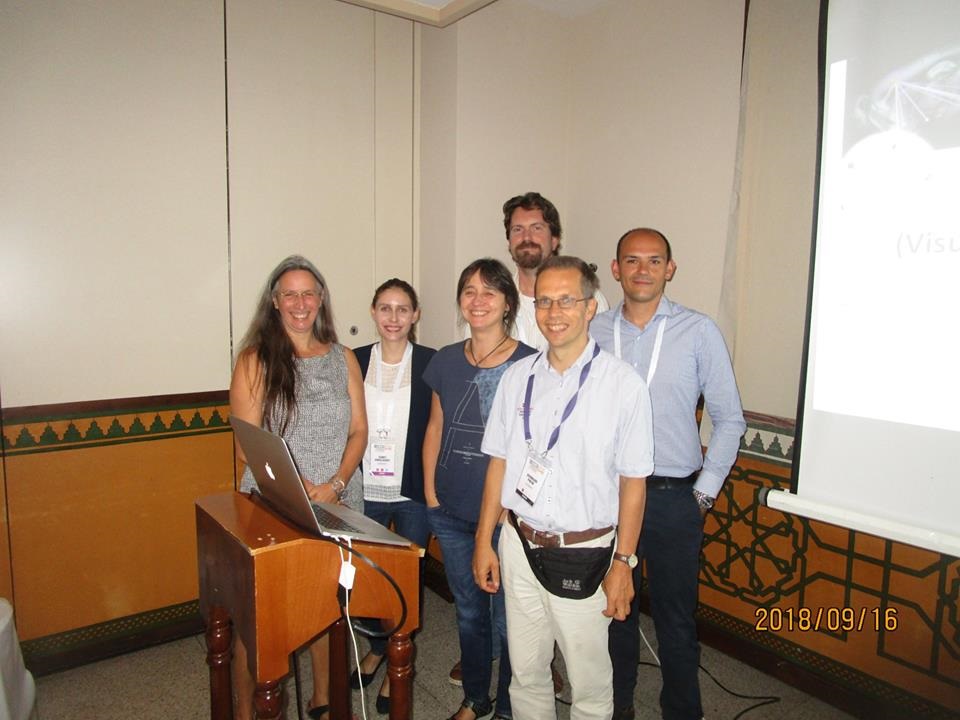
 Finally, Gabriel Mistelbauer presents Popup-Plots, a visualization approach that he designed and developed together with Johanna Schmidt from AIT Austria. The paper deals with the visualization of temporal data, but uses an ellipsoidal coordinate system instead of a conventional Cartesian one. By rotating around the data, the space is bent to successively view more time and the visualization comes out of the image plane. Gabriel Mistelbauer and Johanna Schmidt will also hold a workshop on visual summarization and report generation.

 Negar Chabi, our new Phd student arrived from Iran. She will carry out research on stent detection and stent enhancement in medical image data as part of the
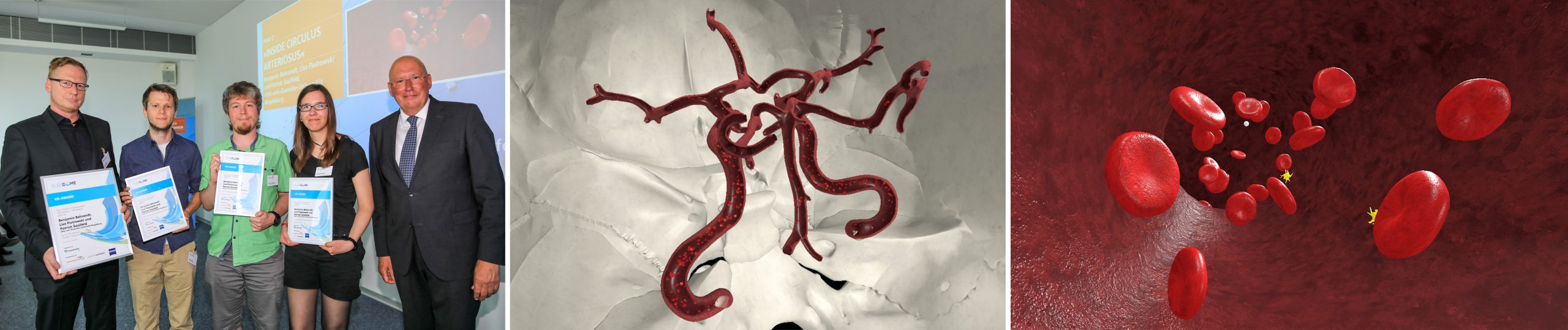
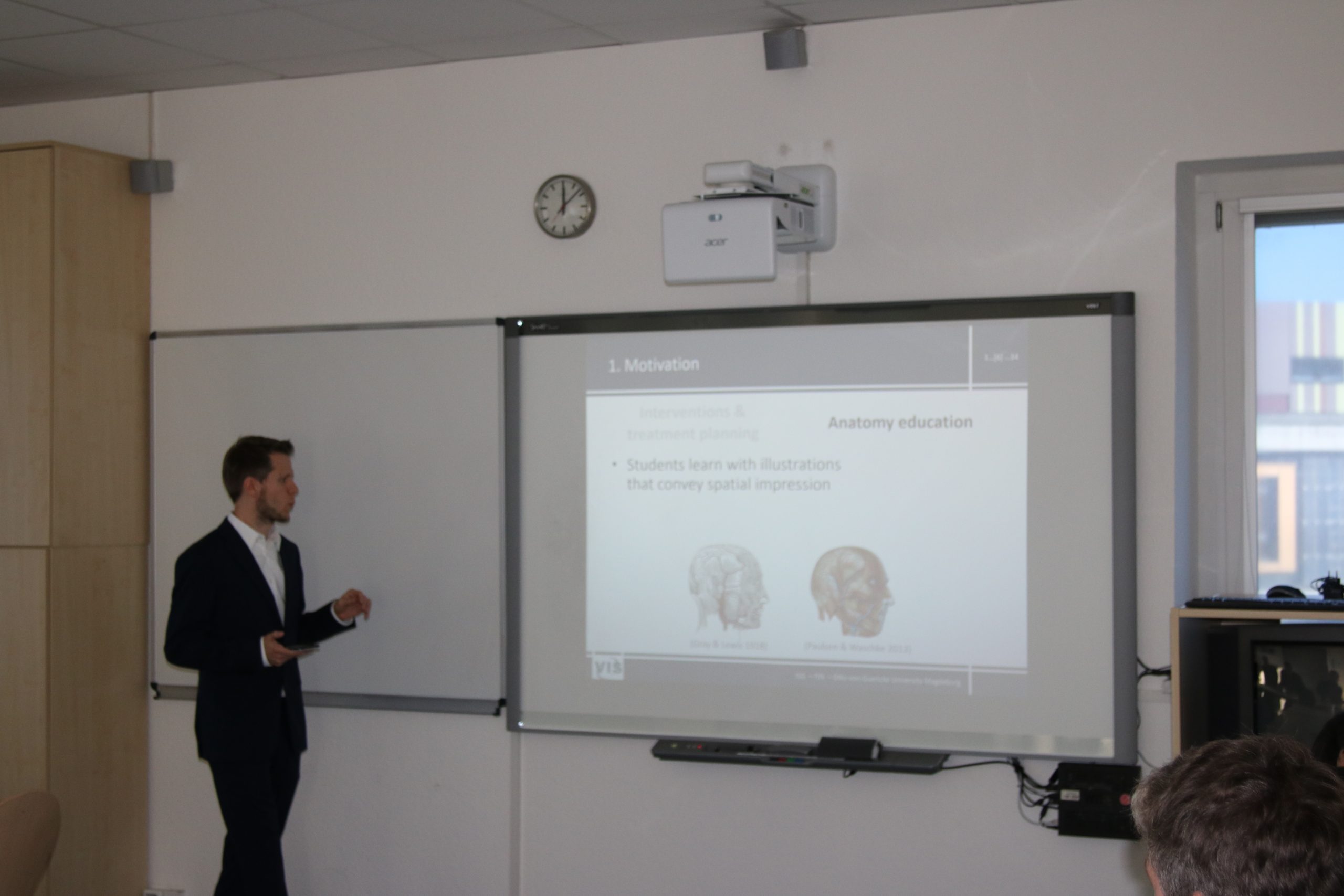
 Patrick Saalfeld has submitted his Phd thesis “3D User Interfaces for Interventional Support and Medical Education” summarizing his work on spatial interaction techniques and devices to support medical treatment planning and education. The developed interaction techniques used on immersive systems resulted in several prices including the Eurographics Medical Price, MedVis-Award and the ElbeDome Award. Patrick’s work was funded by a fellowship from Sachsen-Anhalt and within the BMWi project “Virtual Anatomy”.
 Nico Merten was given the “Held der Lehre” Award for his excercise on “Information Visualization” in Summer term 2017 by the Faculties’ student organization.