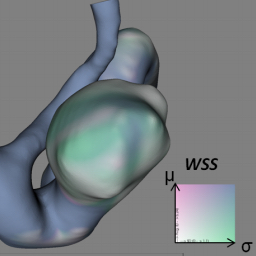
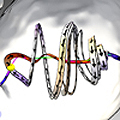
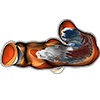
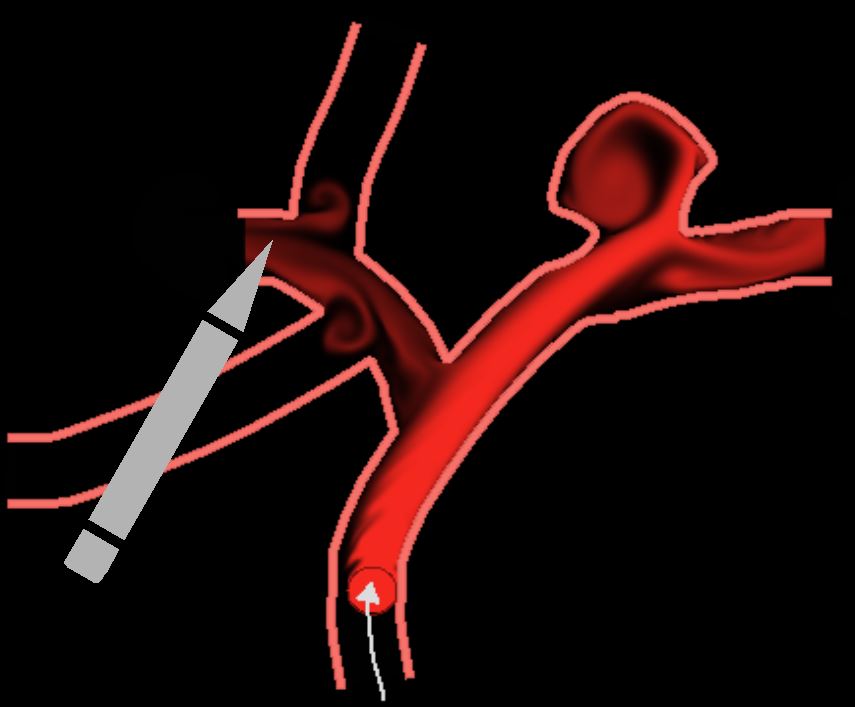
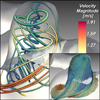
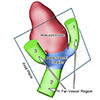
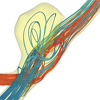
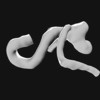
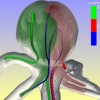
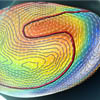
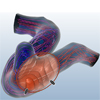
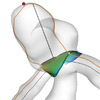
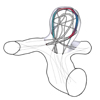
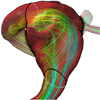
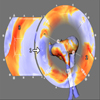
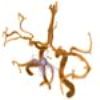
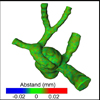
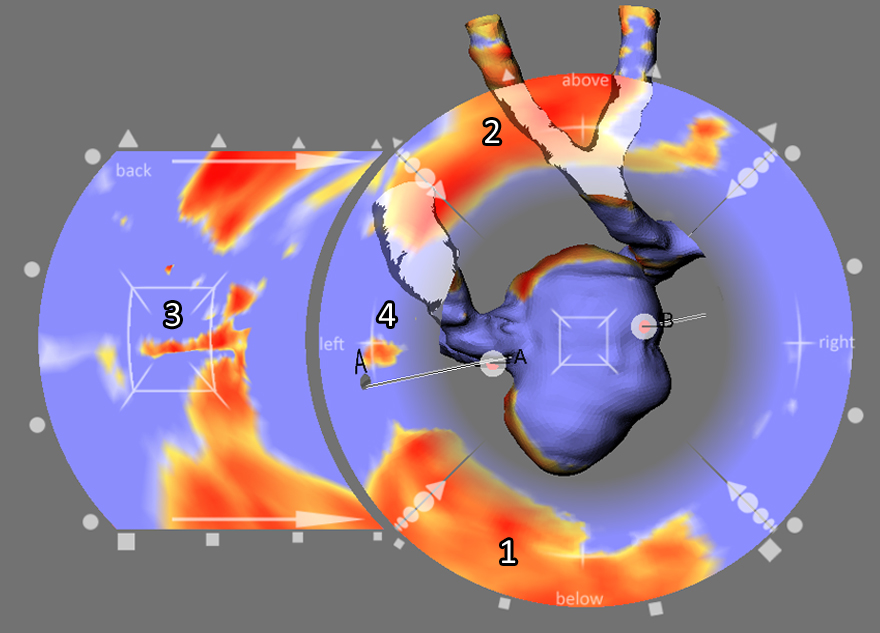
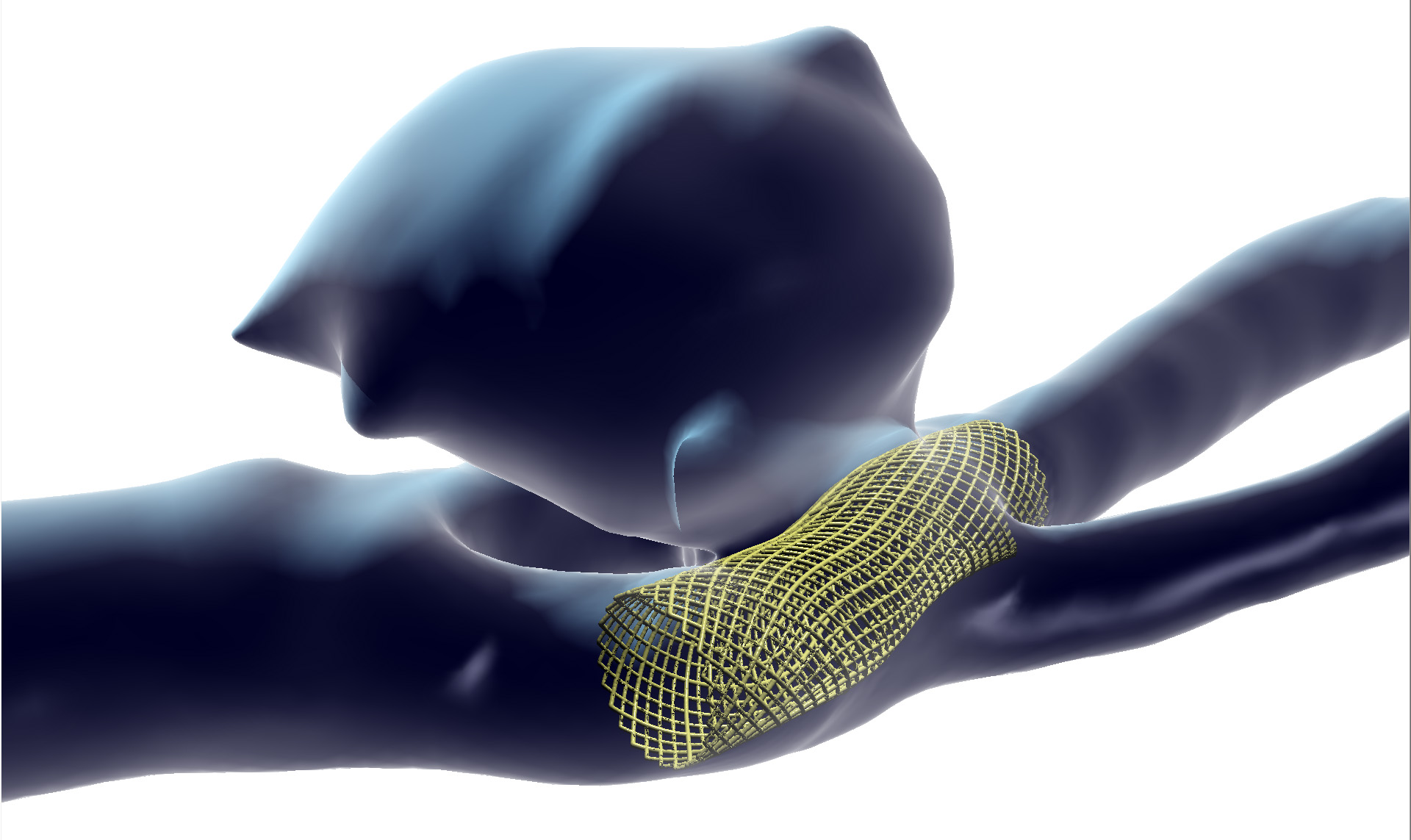
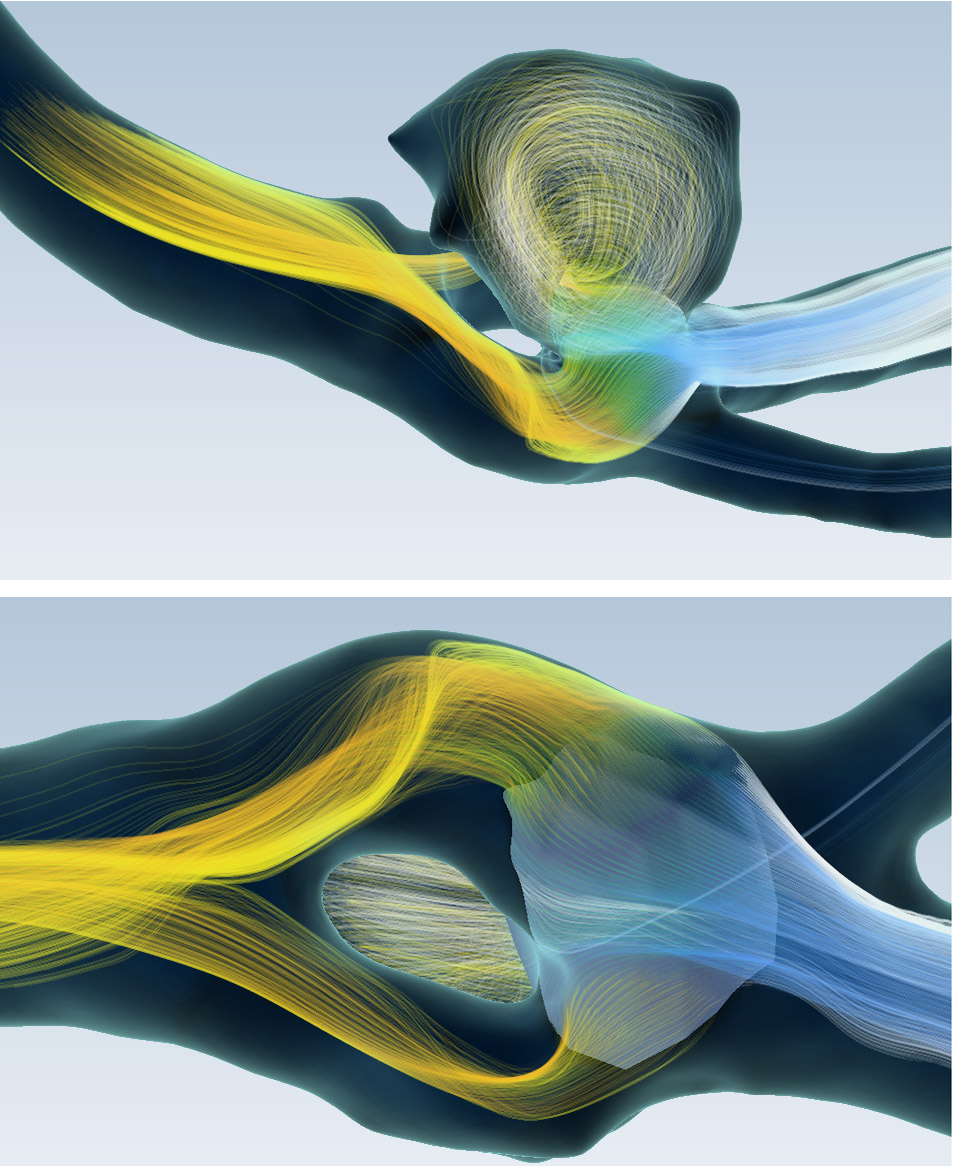
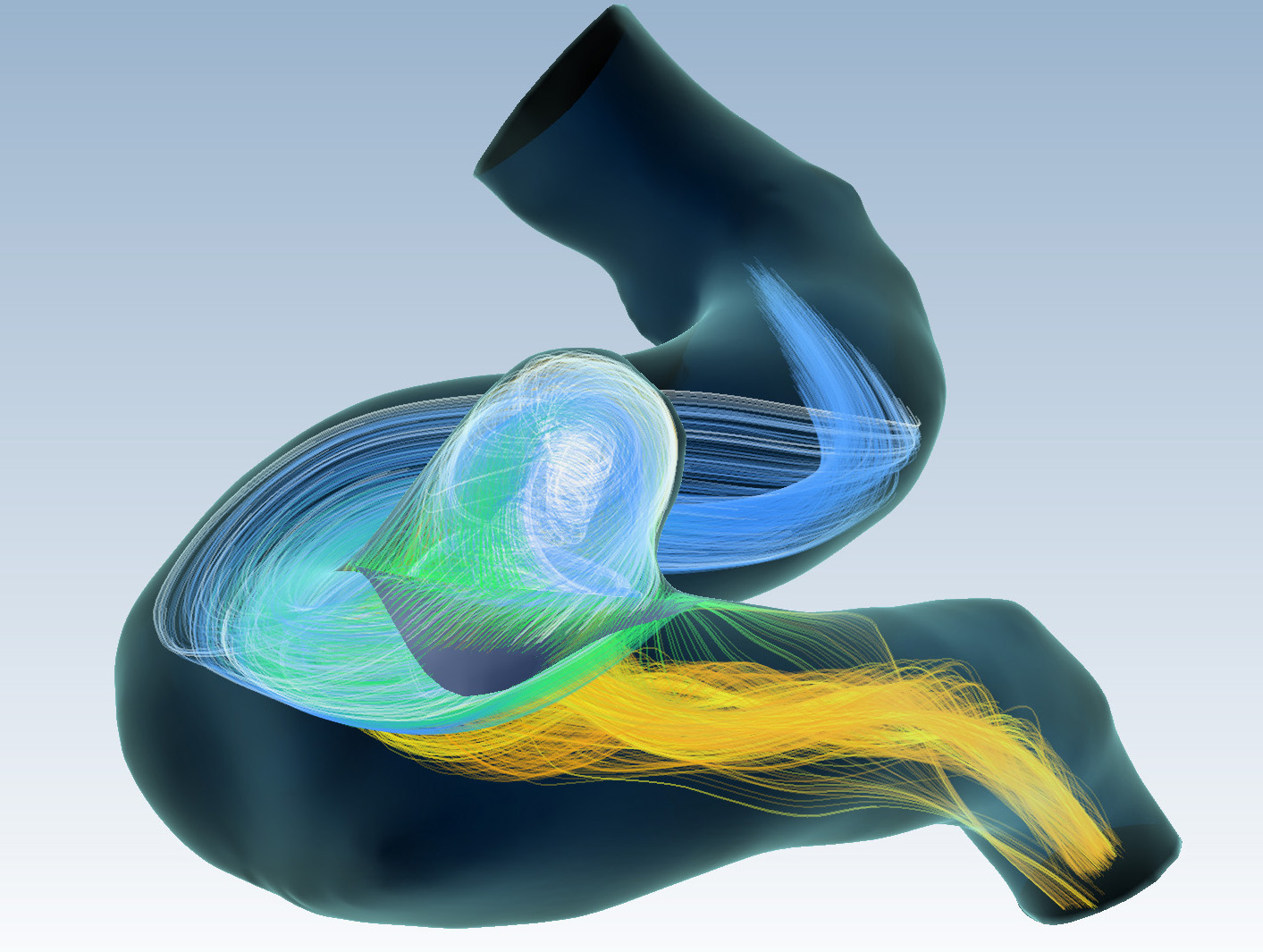
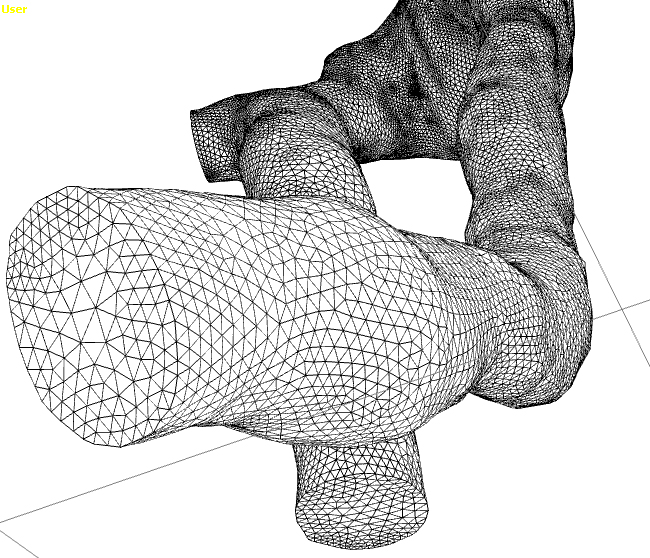
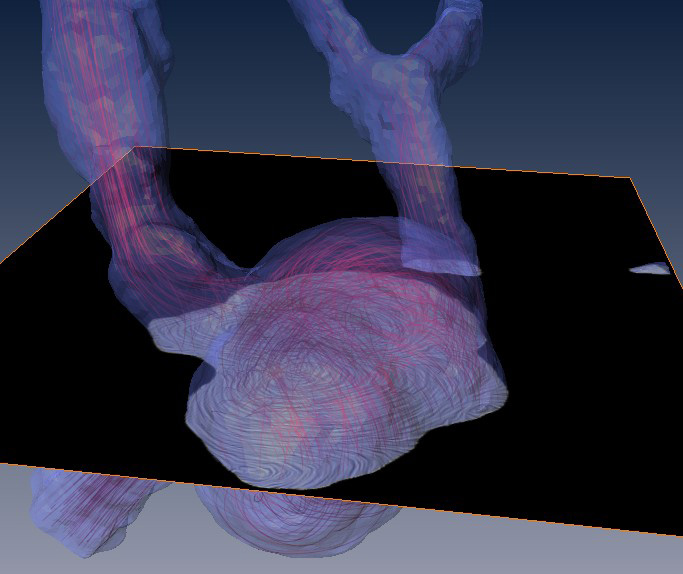
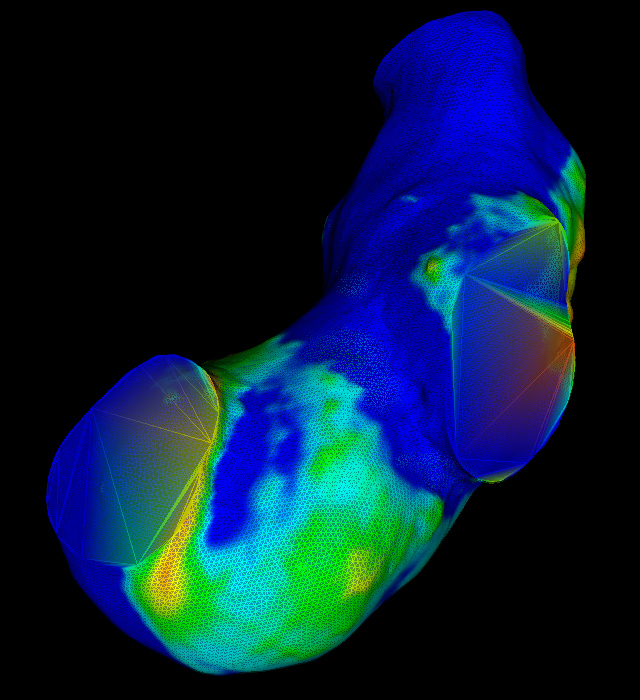
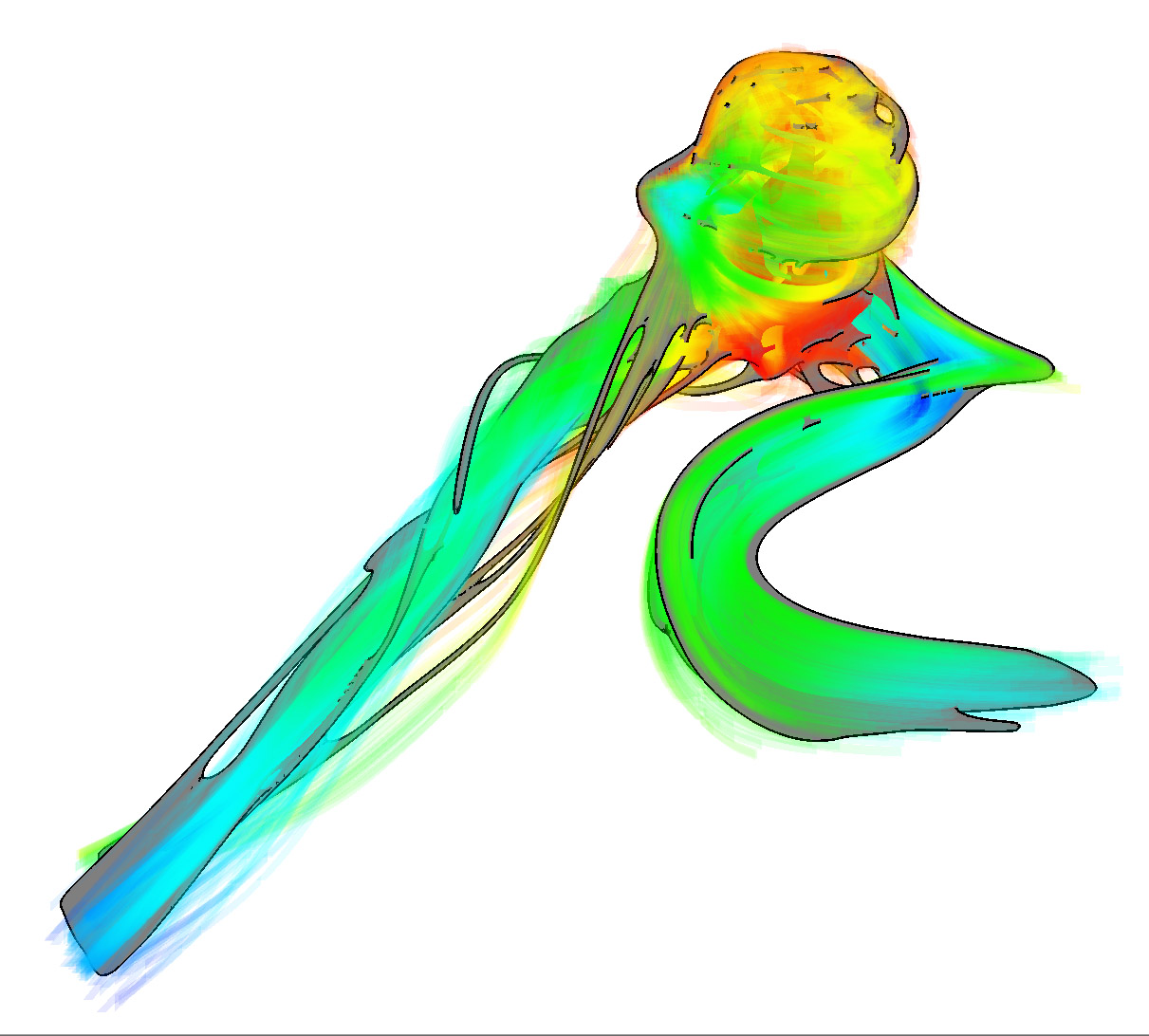
Due to the current advances in the field of medical imaging and an increase of MR and CT brain scans as part of diagnostic procedures, the number of cerebral aneurysm findings is rising. These dilated parts of cerebral arteries exhibit a high risk of rupture, which can lead to internal bleedings with fatal consequences for the patient (mortality rate: up to 60%). To reduce the risk for the patient most of the interventions are performed minimal invasive by filling the aneurysm with small metal coils (Coiling) and stabilizing them with a tubular metal mesh (Stent) if necessary. Since the intervention itself involves the risk of causing an internal bleeding, a detailed risk estimation and a deeper insight into the blood flow dynamics, that influence the development of cerebral aneurysms, is crucial. In current research computational fluid dynamics (CFD) simulation is the common approach to gain a better understanding for the dynamic characteristics of the internal blood flow.
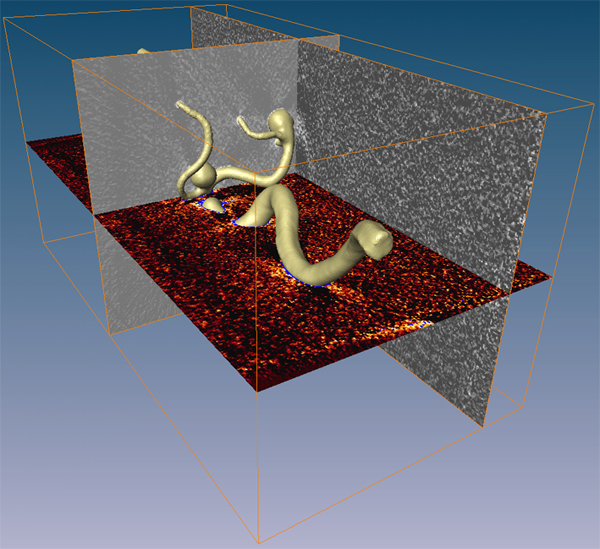
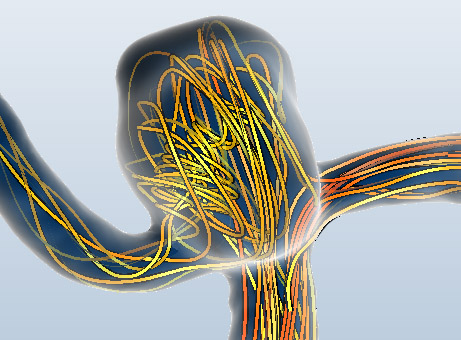
The result of the CFD simulation is a multidimensional and often time dependent dataset. Our aim is to develop an application-specific pipeline to make this complex data accessible to medical researchers. Besides different approaches to visualize the flow characteristics this pipeline also needs to contain the analysis of morphological features and their relation to the flow characteristics. One application of this pipeline is the creation of expressive comparison visualizations in order to gain insight into the development of an aneurysm over time or into the affect a change in the incoming blood-flow has onto the whole dynamic system. Due to the interdisciplinary character of this research area we are working together with Institute of Neuroradiology (medical experts), the Institute of Fluid Dynamics and Thermodynamics (CFD simulation), the Image Processing Workgroup (segmentation), the Institute of Electronics, Signal Processing and Communication Technology (evaluation of the CFD simulation). In October 2008 this cooperation formed the base for the Mobestan project supported by the state of Saxony-Anhalt.
A short summarization of our current field of research:
-
Semi-/automatic extraction and visualization of morphological information and flow features
-
Guided exploration and overview visualization of complex flow datasets
-
Focus & Context visualization of cerebral vasculature
-
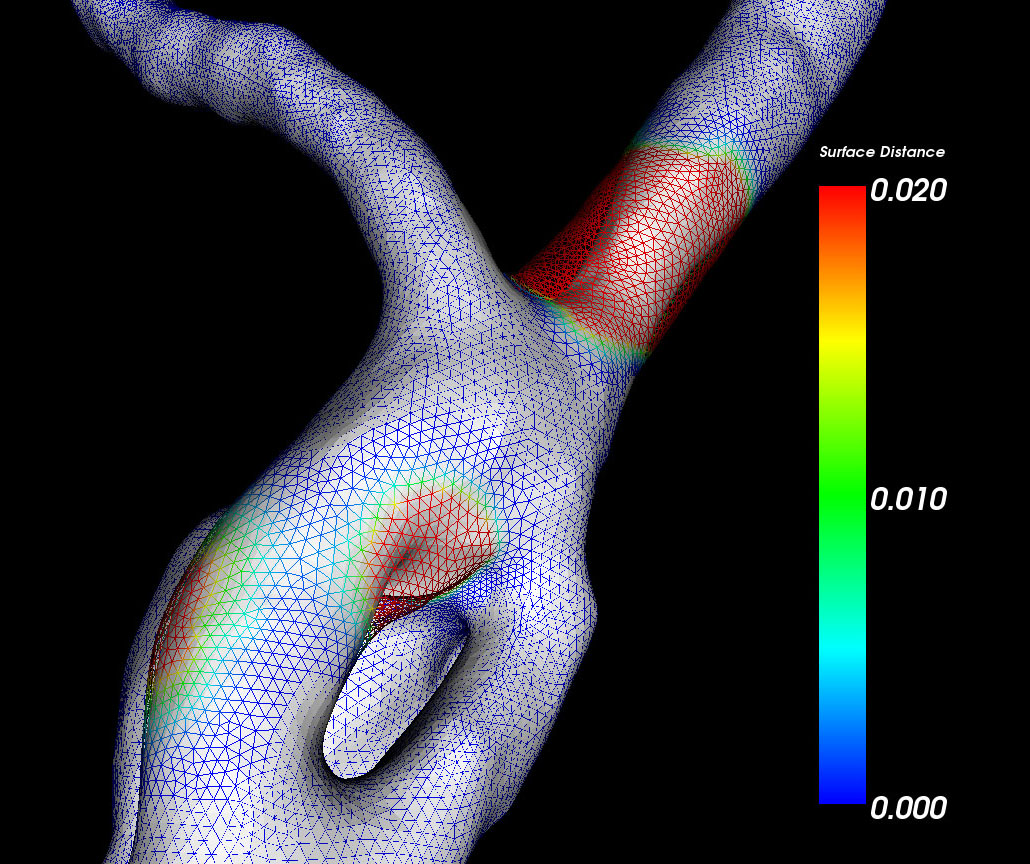
Combined (internal flow data & surface morphology) and comparing (change over time, after stent application, etc.) visualizations
Publications
2016
Sylvia Glaßer, Jan Hirsch, Philipp Berg, Patrick Saalfeld, Oliver Beuing, Gabor Janiga, Bernhard Preim
Evaluation of Time-Dependent Wall Shear Stress Visualizations for Cerebral Aneurysms Proceedings Article
In: Bildverarbeitung für die Medizin (BVM), pp. 236–241, 2016.
@inproceedings{Glasser_2016_BVM,

title = {Evaluation of Time-Dependent Wall Shear Stress Visualizations for Cerebral Aneurysms},

author = {Sylvia Glaßer and Jan Hirsch and Philipp Berg and Patrick Saalfeld and Oliver Beuing and Gabor Janiga and Bernhard Preim},

url = {https://www.vismd.de/wp-content/uploads/legacy/glasser_2016_bvm.pdf, PDF Download},

year  = {2016},

date = {2016-01-01},

booktitle = {Bildverarbeitung für die Medizin (BVM)},

pages = {236--241},

keywords = {},

pubstate = {published},

tppubtype = {inproceedings}

}
Steffen Oeltze-Jafra, Juan R Cebral, Gábor Janiga, Bernhard Preim
Cluster Analysis of Vortical Flow in Simulations of Cerebral Aneurysm Hemodynamics Journal Article
In: IEEE Transactions on Visualization and Computer Graphics (TVCG), vol. 22 (1), no. 1, pp. 757–766, 2016.
@article{Oeltze_2015_TVCG,

title = {Cluster Analysis of Vortical Flow in Simulations of Cerebral Aneurysm Hemodynamics},

author = {Steffen Oeltze-Jafra and Juan R Cebral and Gábor Janiga and Bernhard Preim},

url = {https://www.vismd.de/wp-content/uploads/legacy/oeltze_2015_tvcg.pdf, PDF Download

https://www.youtube.com/watch?v=rAmjHC0zc0c, YouTube},

year  = {2016},

date = {2016-01-01},

journal = {IEEE Transactions on Visualization and Computer Graphics (TVCG)},

volume = {22 (1)},

number = {1},

pages = {757--766},

keywords = {},

pubstate = {published},

tppubtype = {article}

}
2015
Kai Lawonn, Sylvia Glaßer, Anna Vilanova, Bernhard Preim, Tobias Isenberg
Occlusion-free Blood Flow Animation with Wall Thickness Visualization Journal Article
In: IEEE Transactions on Visualization and Computer Graphics (TVCG), vol. 22 (1), no. 1, pp. 728–737, 2015.
@article{Lawonn_2015_TVCG,

title = {Occlusion-free Blood Flow Animation with Wall Thickness Visualization},

author = {Kai Lawonn and Sylvia Glaßer and Anna Vilanova and Bernhard Preim and Tobias Isenberg},

url = {https://www.vismd.de/wp-content/uploads/legacy/lawonn_2015_tvcg.pdf, PDF Download

https://www.youtube.com/watch?v=aIS4_iaNCWk, YouTube},

year  = {2015},

date = {2015-01-01},

journal = {IEEE Transactions on Visualization and Computer Graphics (TVCG)},

volume = {22 (1)},

number = {1},

pages = {728--737},

keywords = {},

pubstate = {published},

tppubtype = {article}

}
Patrick Saalfeld, Alexandra Baer, Uta Preim, Bernhard Preim, Kai Lawonn
Sketching 2D Vessels and Vascular Diseases with Integrated Blood Flow Proceedings Article
In: Proc. of the 10th International Conference on Computer Graphics Theory and Applications (GRAPP), pp. 379–390, Berlin, 2015.
@inproceedings{Saalfeld_2015_GRAPP,

title = {Sketching 2D Vessels and Vascular Diseases with Integrated Blood Flow},

author = {Patrick Saalfeld and Alexandra Baer and Uta Preim and Bernhard Preim and Kai Lawonn},

url = {https://www.vismd.de/wp-content/uploads/legacy/saalfeld_2015_grapp.pdf, PDF Download

https://www.youtube.com/watch?v=hWQ-xqWdsg8, YouTube},

year  = {2015},

date = {2015-00-01},

booktitle = {Proc. of the 10th International Conference on Computer Graphics Theory and Applications (GRAPP)},

pages = {379--390},

address = {Berlin},

keywords = {},

pubstate = {published},

tppubtype = {inproceedings}

}
2014
Steffen Oeltze, Dirk Joachim Lehmann, Alexander Kuhn, Gabor Janiga, Holger Theisel, Bernhard Preim
Blood Flow Clustering and Applications in Virtual Stenting of Intracranial Aneurysms Journal Article
In: IEEE Transactions on Visualization and Computer Graphics (TVCG), vol. 20(5), pp. 686–701, 2014.
@article{Oeltze_2014_TVCG,

title = {Blood Flow Clustering and Applications in Virtual Stenting of Intracranial Aneurysms},

author = {Steffen Oeltze and Dirk Joachim Lehmann and Alexander Kuhn and Gabor Janiga and Holger Theisel and Bernhard Preim},

url = {https://www.vismd.de/wp-content/uploads/legacy/oeltze_2014_tvcg.pdf, PDF Download

https://www.youtube.com/watch?v=-RVVgqDHzdc, YouTube},

year  = {2014},

date = {2014-01-01},

journal = {IEEE Transactions on Visualization and Computer Graphics (TVCG)},

volume = {20(5)},

pages = {686--701},

keywords = {},

pubstate = {published},

tppubtype = {article}

}
Roy van Pelt, Rocco Gasteiger, Kai Lawonn, Monique Meuschke, Bernhard Preim
Comparative Blood Flow Visualization for Cerebral Aneurysm Treatment Assessment Journal Article
In: Computer Graphics Forum (Eurographics Conference on Visualization (EuroVis) 2014), vol. 33(3), no. 3, pp. 131–140, 2014.
@article{Pelt_2014_CGF,

title = {Comparative Blood Flow Visualization for Cerebral Aneurysm Treatment Assessment},

author = {Roy van Pelt and Rocco Gasteiger and Kai Lawonn and Monique Meuschke and Bernhard Preim},

url = {https://www.vismd.de/wp-content/uploads/legacy/pelt_2014_cgf.pdf, PDF Download},

year  = {2014},

date = {2014-00-01},

booktitle = {Eurographics Conference on Visualization (EuroVis) 2014},

journal = {Computer Graphics Forum (Eurographics Conference on Visualization (EuroVis) 2014)},

volume = {33(3)},

number = {3},

pages = {131--140},

address = {Swansea, Wales, UK},

keywords = {},

pubstate = {published},

tppubtype = {article}

}
2013
Mathias Neugebauer, Kai Lawonn, Oliver Beuing, Bernhard Preim
Automatic Generation of Anatomic Characteristics from Cerebral Aneurysm Surface Models Journal Article
In: International Journal of Computer Assisted Radiology and Surgery, vol. 8(2), pp. 279–289, 2013.
@article{Neugebauer_2013_JCARS,

title = {Automatic Generation of Anatomic Characteristics from Cerebral Aneurysm Surface Models},

author = {Mathias Neugebauer and Kai Lawonn and Oliver Beuing and Bernhard Preim},

url = {https://www.vismd.de/wp-content/uploads/legacy/neugebauer_2013_jcars.pdf, PDF Download},

year  = {2013},

date = {2013-03-01},

journal = {International Journal of Computer Assisted Radiology and Surgery},

volume = {8(2)},

pages = {279--289},

keywords = {},

pubstate = {published},

tppubtype = {article}

}
Mathias Neugebauer, Kai Lawonn, Oliver Beuing, Philipp Berg, Gabor Janiga, Bernhard Preim
AmniVis - A System for Qualitative Exploration of Near-Wall Hemodynamics in Cerebral Aneurysms Journal Article
In: Computer Graphics Forum, vol. 32(3), pp. 251–260, 2013.
@article{Neugebauer_2013_CGF,

title = {AmniVis - A System for Qualitative Exploration of Near-Wall Hemodynamics in Cerebral Aneurysms},

author = {Mathias Neugebauer and Kai Lawonn and Oliver Beuing and Philipp Berg and Gabor Janiga and Bernhard Preim},

url = {https://www.vismd.de/wp-content/uploads/legacy/neugebauer_2013_cgf.pdf, PDF Download

https://www.youtube.com/watch?v=Tg8T6vKAOdw, YouTube},

year  = {2013},

date = {2013-01-01},

journal = {Computer Graphics Forum},

volume = {32(3)},

pages = {251--260},

keywords = {},

pubstate = {published},

tppubtype = {article}

}
Gabor Janiga, Philipp Berg, Oliver Beuing, Mathias Neugebauer, Rocco Gasteiger, Bernhard Preim, Georg Rose, Martin Skalej, Dominque Thevenin
Recommendations for accurate numerical blood flow simulations of stented intracranial aneurysms Journal Article
In: Biomedical Engineering, vol. 58 (3), pp. 303–-314, 2013.
@article{Janiga_2013_BioEng,

title = {Recommendations for accurate numerical blood flow simulations of stented intracranial aneurysms},

author = {Gabor Janiga and Philipp Berg and Oliver Beuing and Mathias Neugebauer and Rocco Gasteiger and Bernhard Preim and Georg Rose and Martin Skalej and Dominque Thevenin},

url = {https://www.vismd.de/wp-content/uploads/legacy/janiga_2013_bioeng.pdf, PDF Download},

year  = {2013},

date = {2013-01-01},

journal = {Biomedical Engineering},

volume = {58 (3)},

pages = {303---314},

keywords = {},

pubstate = {published},

tppubtype = {article}

}
2012
Rocco Gasteiger, Dirk Joachim Lehmann, Roy van Pelt, Gabor Janiga, Oliver Beuing, Anna Vilanova, Holger Theisel, Bernhard Preim
Automatic Detection and Visualization of Qualitative Hemodynamic Characteristics in Cerebral Aneurysms Journal Article
In: IEEE Transactions on Visualization and Computer Graphics (TVCG), vol. 18(12), no. 12, pp. 2178–2187, 2012.
@article{Gasteiger_2012_VIS,

title = {Automatic Detection and Visualization of Qualitative Hemodynamic Characteristics in Cerebral Aneurysms},

author = {Rocco Gasteiger and Dirk Joachim Lehmann and Roy van Pelt and Gabor Janiga and Oliver Beuing and Anna Vilanova and Holger Theisel and Bernhard Preim},

url = {https://www.vismd.de/wp-content/uploads/legacy/gasteiger_2012_vis.pdf, PDF Download

https://www.youtube.com/watch?v=6ULv7rhi0mI, YouTube},

year  = {2012},

date = {2012-12-01},

journal = {IEEE Transactions on Visualization and Computer Graphics (TVCG)},

volume = {18(12)},

number = {12},

pages = {2178--2187},

keywords = {},

pubstate = {published},

tppubtype = {article}

}
Benjamin Köhler, Mathias Neugebauer, Rocco Gasteiger, Gábor Janiga, Oliver Speck, Bernhard Preim
Surface-Based Seeding for Blood Flow Exploration Proceedings Article
In: Bildverarbeitung für die Medizin, pp. 81–86, Berlin, 2012.
@inproceedings{Koehler_2012_BVM,

title = {Surface-Based Seeding for Blood Flow Exploration},

author = {Benjamin Köhler and Mathias Neugebauer and Rocco Gasteiger and Gábor Janiga and Oliver Speck and Bernhard Preim},

url = {https://www.vismd.de/wp-content/uploads/legacy/koehler_2012_bvm.pdf, PDF Download},

year  = {2012},

date = {2012-00-01},

booktitle = {Bildverarbeitung für die Medizin},

pages = {81--86},

address = {Berlin},

keywords = {},

pubstate = {published},

tppubtype = {inproceedings}

}
Steffen Oeltze, Dirk Joachim Lehmann, Holger Theisel, Bernhard Preim
Evaluation of Streamline Clustering Techniques for Blood Flow Data Technical Report
Otto-von-Guericke-Universität Magdeburg no. FIN-06-2012, 2012.
@techreport{Oeltze_2012_TR,

title = {Evaluation of Streamline Clustering Techniques for Blood Flow Data},

author = {Steffen Oeltze and Dirk Joachim Lehmann and Holger Theisel and Bernhard Preim},

url = {https://www.vismd.de/wp-content/uploads/legacy/oeltze_2012_tr.pdf, PDF Download},

year  = {2012},

date = {2012-00-01},

number = {FIN-06-2012},

institution = {Otto-von-Guericke-Universität Magdeburg},

keywords = {},

pubstate = {published},

tppubtype = {techreport}

}
2011
Mathias Neugebauer, Gabor Janiga, Oliver Beuing, Martin Skalej, Bernhard Preim
Anatomy-Guided Multi-Level Exploration of Blood Flow in Cerebral Aneurysms Journal Article
In: Computer Graphics Forum (EuroVis), vol. 30(3), pp. 1041–1050, 2011.
@article{Neugebauer_2011_Eurovis,

title = {Anatomy-Guided Multi-Level Exploration of Blood Flow in Cerebral Aneurysms},

author = {Mathias Neugebauer and Gabor Janiga and Oliver Beuing and Martin Skalej and Bernhard Preim},

url = {https://www.vismd.de/wp-content/uploads/legacy/neugebauer_2011_eurovis.pdf, PDF Download

https://www.youtube.com/watch?v=NnCgS6G4DWc, YouTube},

year  = {2011},

date = {2011-01-01},

journal = {Computer Graphics Forum (EuroVis)},

volume = {30(3)},

pages = {1041--1050},

keywords = {},

pubstate = {published},

tppubtype = {article}

}
Rocco Gasteiger, Mathias Neugebauer, Oliver Beuing, Bernhard Preim
The FLOWLENS: A Focus-and-Context Visualization Approach for Exploration of Blood Flow in Cerebral Aneurysms Journal Article
In: IEEE Transactions on Visualization and Computer Graphics (TVCG), vol. 17, no. 12, pp. 2183-2192, 2011.
@article{Gasteiger_2011_VIS,

title = {The FLOWLENS: A Focus-and-Context Visualization Approach for Exploration of Blood Flow in Cerebral Aneurysms},

author = {Rocco Gasteiger and Mathias Neugebauer and Oliver Beuing and Bernhard Preim},

url = {https://www.vismd.de/wp-content/uploads/legacy/gasteiger_2011_vis.pdf, PDF Download

https://www.youtube.com/watch?v=6JdhGyl0dQA, YouTube},

year  = {2011},

date = {2011-01-01},

journal = {IEEE Transactions on Visualization and Computer Graphics (TVCG)},

volume = {17},

number = {12},

pages = {2183-2192},

keywords = {},

pubstate = {published},

tppubtype = {article}

}
Mathias Neugebauer, Bernhard Preim
Generation of a Smooth Ostium Surface for Aneurysm Surface Models Proceedings Article
In: Bildverarbeitung für die Medizin (BVM), pp. 399–403, Lübeck, 2011.
@inproceedings{Neugebauer_2011_BVM,

title = {Generation of a Smooth Ostium Surface for Aneurysm Surface Models},

author = {Mathias Neugebauer and Bernhard Preim},

url = {https://www.vismd.de/wp-content/uploads/legacy/neugebauer_2011_bvm.pdf, PDF Download},

year  = {2011},

date = {2011-00-01},

booktitle = {Bildverarbeitung für die Medizin (BVM)},

pages = {399--403},

address = {Lübeck},

keywords = {},

pubstate = {published},

tppubtype = {inproceedings}

}
Rocco Gasteiger, Gabor Janiga, Daniel Stucht, Anja Hennemuth, Ola Friman, Oliver Speck, Michael Markl, Bernhard Preim
Vergleich zwischen 7 Tesla 4D PC-MRI Flussmessung und CFD-Simulation Proceedings Article
In: Bildverarbeitung für die Medizin (BVM), pp. 304–308, Lübeck, 2011.
@inproceedings{Gasteiger_2011_BVM,

title = {Vergleich zwischen 7 Tesla 4D PC-MRI Flussmessung und CFD-Simulation},

author = {Rocco Gasteiger and Gabor Janiga and Daniel Stucht and Anja Hennemuth and Ola Friman and Oliver Speck and Michael Markl and Bernhard Preim},

url = {https://www.vismd.de/wp-content/uploads/legacy/gasteiger_2011_bvm.pdf, PDF Download},

year  = {2011},

date = {2011-00-01},

booktitle = {Bildverarbeitung für die Medizin (BVM)},

pages = {304--308},

address = {Lübeck},

keywords = {},

pubstate = {published},

tppubtype = {inproceedings}

}
Daniel Stucht, Rocco Gasteiger, Steffen Serowy, Michael Markl, Bernhard Preim, Oliver Speck
Bildbasierte Korrektur von Phasensprüngen in 4D PC-MRI Flussdaten Proceedings Article
In: Bildverarbeitung für die Medizin (BVM), pp. 424–428, Lübeck, 2011.
@inproceedings{Stucht_2011_BVM,

title = {Bildbasierte Korrektur von Phasensprüngen in 4D PC-MRI Flussdaten},

author = {Daniel Stucht and Rocco Gasteiger and Steffen Serowy and Michael Markl and Bernhard Preim and Oliver Speck},

url = {https://www.vismd.de/wp-content/uploads/legacy/stucht_2011_bvm.pdf, PDF Download},

year  = {2011},

date = {2011-00-01},

booktitle = {Bildverarbeitung für die Medizin (BVM)},

pages = {424--428},

address = {Lübeck},

keywords = {},

pubstate = {published},

tppubtype = {inproceedings}

}
2010
Mathias Neugebauer, Volker Diehl, Martin Skalej, Bernhard Preim
Geometric Reconstruction of the Ostium of Cerebral Aneurysms Proceedings Article
In: Koch, Reinhard; Kolb, Andreas; Rezk-Salama, Christopf (Ed.): VMV 2010 - Vision, Modeling, Visualization, pp. 307–314, Siegen, 2010.
@inproceedings{Neugebauer_2010_VMV,

title = {Geometric Reconstruction of the Ostium of Cerebral Aneurysms},

author = {Mathias Neugebauer and Volker Diehl and Martin Skalej and Bernhard Preim},

editor = {Reinhard Koch and Andreas Kolb and Christopf Rezk-Salama},

url = {https://www.vismd.de/wp-content/uploads/legacy/neugebauer_2010_vmv.pdf, PDF Download

https://www.youtube.com/watch?v=49CZWr2F5mI, YouTube},

year  = {2010},

date = {2010-11-01},

booktitle = {VMV 2010 - Vision, Modeling, Visualization},

pages = {307--314},

address = {Siegen},

keywords = {},

pubstate = {published},

tppubtype = {inproceedings}

}
Rocco Gasteiger, Mathias Neugebauer, Volker Diehl, Oliver Beuing, Bernhard Preim
Entwurf einer angepassten Visualisierung von zerebralen Aneurysmen mit innenliegenden Blutflussinformationen Proceedings Article
In: Proc. of CURAC, pp. 61–66, Düsseldorf, 2010.
@inproceedings{Gasteiger_2010_CURAC,

title = {Entwurf einer angepassten Visualisierung von zerebralen Aneurysmen mit innenliegenden Blutflussinformationen},

author = {Rocco Gasteiger and Mathias Neugebauer and Volker Diehl and Oliver Beuing and Bernhard Preim},

url = {https://www.vismd.de/wp-content/uploads/legacy/gasteiger_2010_curac.pdf, PDF Download},

year  = {2010},

date = {2010-11-01},

booktitle = {Proc. of CURAC},

pages = {61--66},

address = {Düsseldorf},

keywords = {},

pubstate = {published},

tppubtype = {inproceedings}

}
Mathias Neugebauer, Gabor Janiga, Oliver Beuing, Martin Skalej, Bernhard Preim
Modellbildung und Simulation - Computer-Aided Modelling of Blood Flow for the Treatment of Cerebral Aneurysms Journal Article
In: Biomed Tech, vol. 55, no. Suppl. 1, pp. 37–41, 2010.
@article{Neugebauer_2010_BMT,

title = {Modellbildung und Simulation - Computer-Aided Modelling of Blood Flow for the Treatment of Cerebral Aneurysms},

author = {Mathias Neugebauer and Gabor Janiga and Oliver Beuing and Martin Skalej and Bernhard Preim},

url = {https://www.vismd.de/wp-content/uploads/legacy/neugebauer_2010_bmt.pdf, PDF Download},

year  = {2010},

date = {2010-01-01},

journal = {Biomed Tech},

volume = {55},

number = {Suppl. 1},

pages = {37--41},

keywords = {},

pubstate = {published},

tppubtype = {article}

}
Rocco Gasteiger, Mathias Neugebauer, Christoph Kubisch, Bernhard Preim
Adapted Surface Visualization of Cerebral Aneurysms with Embedded Blood Flow Information Proceedings Article
In: Eurographics Workshop on Visual Computing for Biology and Medicine (EG VCBM), pp. 25-32, 2010.
@inproceedings{Gasteiger_2010_VCBM,

title = {Adapted Surface Visualization of Cerebral Aneurysms with Embedded Blood Flow Information},

author = {Rocco Gasteiger and Mathias Neugebauer and Christoph Kubisch and Bernhard Preim},

url = {https://www.vismd.de/wp-content/uploads/legacy/gasteiger_2010_vcbm.pdf, PDF Download

https://www.youtube.com/watch?v=cvSKKj8CF8Q, YouTube},

year  = {2010},

date = {2010-01-01},

booktitle = {Eurographics Workshop on Visual Computing for Biology and Medicine (EG VCBM)},

pages = {25-32},

keywords = {},

pubstate = {published},

tppubtype = {inproceedings}

}
2009
Mathias Neugebauer, Rocco Gasteiger, Oliver Beuing, Volker Diehl, Martin Skalej, Bernhard Preim
Map Displays for the Analysis of Scalar Data on Cerebral Aneurysm Surfaces Proceedings Article
In: Computer Graphics Forum (EuroVis), pp. 895–902, Berlin, 2009.
@inproceedings{Neugebauer_2009_Eurovis,

title = {Map Displays for the Analysis of Scalar Data on Cerebral Aneurysm Surfaces},

author = {Mathias Neugebauer and Rocco Gasteiger and Oliver Beuing and Volker Diehl and Martin Skalej and Bernhard Preim},

url = {https://www.vismd.de/wp-content/uploads/legacy/neugebauer_2009_eurovis.pdf, PDF Download

https://www.youtube.com/watch?v=NcUjbqHct-M, YouTube},

year  = {2009},

date = {2009-00-01},

booktitle = {Computer Graphics Forum (EuroVis)},

volume = {28 (3)},

pages = {895--902},

address = {Berlin},

keywords = {},

pubstate = {published},

tppubtype = {inproceedings}

}
Mathias Neugebauer, Rocco Gasteiger, Volker Diehl, Oliver Beuing, Bernhard Preim
Automatic generation of context visualizations for cerebral aneurysms from MRA datasets Journal Article
In: International Journal of Computer Assisted Radiology and Surgery (CARS), vol. 4 (Supplement 1), pp. 112–113, 2009.
@article{Neugebauer_2009_CARS,

title = {Automatic generation of context visualizations for cerebral aneurysms from MRA datasets},

author = {Mathias Neugebauer and Rocco Gasteiger and Volker Diehl and Oliver Beuing and Bernhard Preim},

url = {https://www.vismd.de/wp-content/uploads/legacy/neugebauer_2009_cars.pdf, PDF Download},

year  = {2009},

date = {2009-00-01},

journal = {International Journal of Computer Assisted Radiology and Surgery (CARS)},

volume = {4 (Supplement 1)},

pages = {112--113},

keywords = {},

pubstate = {published},

tppubtype = {article}

}
2008
Matthias Neugebauer, Gabor Janiga, S Zachow, Martin Skalej, Bernhard Preim
Generierung qualitativ hochwertiger Modelle für die Simulation von Blutfluss in zerebralen Aneurysmen Proceedings Article
In: Proc. Simulation and Visualization, pp. 221–236, 2008.
@inproceedings{Neugebauer_2008_SimVis,

title = {Generierung qualitativ hochwertiger Modelle für die Simulation von Blutfluss in zerebralen Aneurysmen},

author = {Matthias Neugebauer and Gabor Janiga and S Zachow and Martin Skalej and Bernhard Preim},

url = {https://www.vismd.de/wp-content/uploads/legacy/neugebauer_2008_simvis.pdf, PDF Download},

year  = {2008},

date = {2008-01-01},

booktitle = {Proc. Simulation and Visualization},

pages = {221--236},

keywords = {},

pubstate = {published},

tppubtype = {inproceedings}

}
Images