
2026
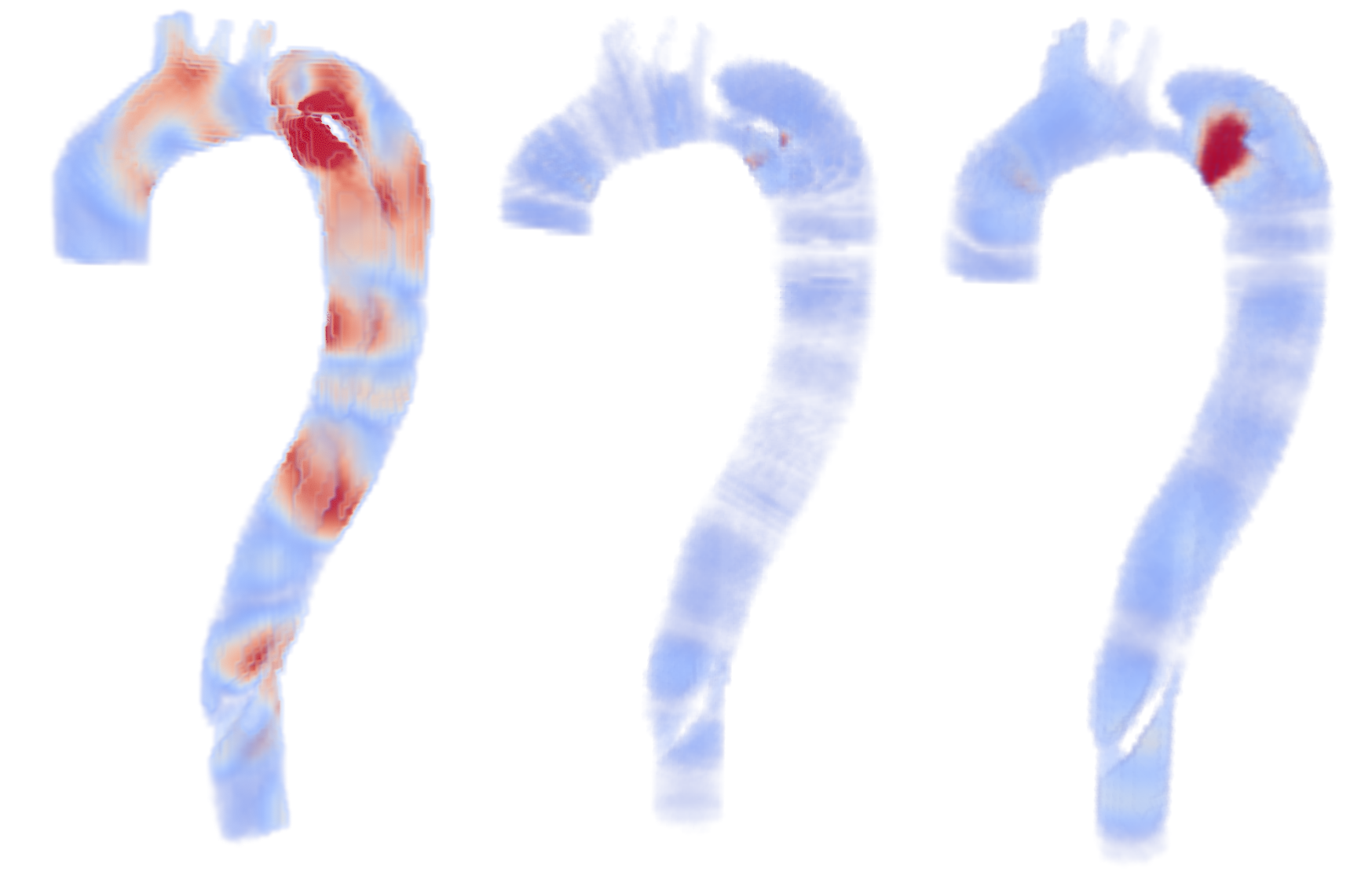
Schroeder, Aaron, Horvat, Anja, Ostendorf, Kai, Bäumler, Kathrin, Mastrodicasa, Domenico, Kerschbaumer, Nina, Fleischmann, Dominik, Preim, Bernhard, Mistelbauer, Gabriel
Vessel-straightening-based Registration for Aortic Flow Comparison Conference
Proc. of Eurographics Symposium on Visual Computing for Biology and Medicine, 2026.
BibTeX | Links:
@conference{Schroeder2026,

title = {Vessel-straightening-based Registration for Aortic Flow Comparison},

author = {Aaron Schroeder and Anja Horvat and Kai Ostendorf and Kathrin Bäumler and Domenico Mastrodicasa and Nina Kerschbaumer and Dominik Fleischmann and Bernhard Preim and Gabriel Mistelbauer},

url = {https://www.vismd.de/wp-content/uploads/2026/09/Vessel-straightening-based-Registration-for-Aortic-Flow-Comparison_Schroeder.pdf},

year  = {2026},

date = {2026-09-17},

urldate = {2026-09-17},

booktitle = {Proc. of Eurographics Symposium on Visual Computing for Biology and Medicine},

pages = {to print},

keywords = {},

pubstate = {published},

tppubtype = {conference}

}
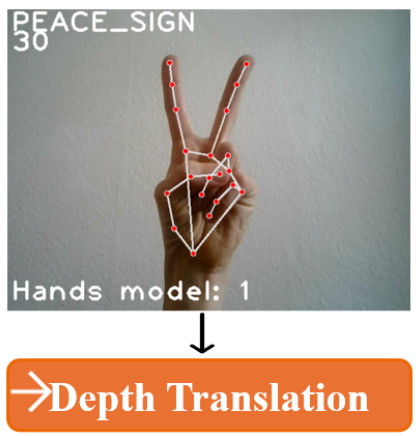
Mueller, Lisa, Preim, Bernhard, Krueger, Sebastian
RGB-Based 2.5D Gesture Interaction with Volumetric Medical Data on an Autostereoscopic Display Workshop Forthcoming
Forthcoming.
@workshop{Mueller2026,

title = {RGB-Based 2.5D Gesture Interaction with Volumetric Medical Data on an Autostereoscopic Display},

author = {Lisa Mueller and Bernhard Preim and Sebastian Krueger},

url = {https://www.vismd.de/wp-content/uploads/2026/08/VCBM_2026_LaTeXAuthor_Paper-2.pdf},

year  = {2026},

date = {2026-08-17},

urldate = {2026-08-17},

abstract = {Touchless interaction with volumetric medical data on autostereoscopic displays offers an intuitive way to explore

3D information in sterile and hardware-light environments. We present an RGB-based 2.5D hand tracking system

for gesture-based manipulation of medical data, supporting translation, rotation, zooming, and depth translation.

A user study with twelve technically experienced participants evaluates usability, workload, and task performance.

The results indicate high usability (SUS = 80) and low to moderate workload, suggesting that RGB-based tracking

can support intuitive exploratory interaction. However, rotation and depth-related tasks show higher variability

due to gesture recognition instability and the lack of absolute depth information. Overall, the approach is suitable

for exploratory visualization, while precise 3D control remains limited.},

howpublished = {VCBM},

keywords = {},

pubstate = {forthcoming},

tppubtype = {workshop}

}
3D information in sterile and hardware-light environments. We present an RGB-based 2.5D hand tracking system
for gesture-based manipulation of medical data, supporting translation, rotation, zooming, and depth translation.
A user study with twelve technically experienced participants evaluates usability, workload, and task performance.
The results indicate high usability (SUS = 80) and low to moderate workload, suggesting that RGB-based tracking
can support intuitive exploratory interaction. However, rotation and depth-related tasks show higher variability
due to gesture recognition instability and the lack of absolute depth information. Overall, the approach is suitable
for exploratory visualization, while precise 3D control remains limited.
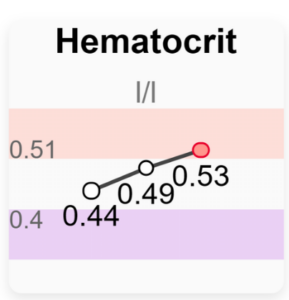
Grellmann, Tabea, Preim, Bernhard, Meuschke, Monique
LabTiles: An Exploratory Small-Multiples Design for Patient-Facing Blood Test Results Conference Forthcoming
Proc. of Eurographics Symposium on Visual Computing for Biology and Medicine, Forthcoming.
BibTeX | Links:
@conference{Grellmann2026,

title = {LabTiles: An Exploratory Small-Multiples Design for Patient-Facing Blood Test Results},

author = {Tabea Grellmann and Bernhard Preim and Monique Meuschke},

url = {https://www.vismd.de/wp-content/uploads/2026/08/paper1017_CRC.pdf},

year  = {2026},

date = {2026-08-12},

urldate = {2026-08-12},

booktitle = {Proc. of Eurographics Symposium on Visual Computing for Biology and Medicine},

pages = {to print},

keywords = {},

pubstate = {forthcoming},

tppubtype = {conference}

}
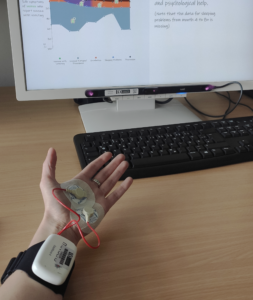
Budich, Beatrice, Garrison, Laura, Vaudel, Marc, Trovik, Jone, Heinrich, Florian, Preim, Bernhard, Meuschke, Monique
Emotional Engagement in Narrative Medical Visualization: An Electrodermal Activity and Eye-Tracking Study Journal Article Forthcoming
In: TVCG, Forthcoming.
@article{Budich2026,

title = {Emotional Engagement in Narrative Medical Visualization: An Electrodermal Activity and Eye-Tracking Study},

author = {Beatrice Budich and Laura Garrison and Marc Vaudel and Jone Trovik and Florian Heinrich and Bernhard Preim and Monique Meuschke},

url = {https://www.vismd.de/wp-content/uploads/2026/08/Emotional_Engagement_in_Narrative_Medical_Visualization__An_Electrodermal_Activity_and_Eye_Tracking_Study-2.pdf},

year  = {2026},

date = {2026-08-05},

urldate = {2026-08-05},

journal = {TVCG},

abstract = {Narrative visualization embeds data in visual stories to make medical information more relatable for non-experts. Despite

the growing use of character elements in health communication, evidence on whether individual characters support affective responses

remains inconclusive. Physiological evidence independent of verbal self-report is especially scarce, although such measures should

complement participants’ self-reported experiences. We present a mixed-methods study using electrodermal activity (EDA), eye

tracking, and questionnaires to compare two medical data stories: an individual, character-based version and a general, population-level

version without an individual protagonist. We examine how this framing influences physiological arousal, visual attention, viewing

behavior, and self-reported affective response. Story-level EDA comparisons provide only limited support for stronger arousal in

the character-based story. Stronger evidence comes from eye-tracking-based peak classification, where character illustrations were

robustly associated with EDA peaks, and from questionnaire responses showing more negative empathy-related emotions for the

individual story. The general story elicited more awe and joy, suggesting that individual and population-level framings may support

different emotional qualities. We also observed a preliminary story-order effect: participants who first saw the individual story showed

higher peak-based physiological arousal, although this effect cannot be fully disentangled from fatigue, novelty, or learning effects. By

combining physiological, gaze-based, questionnaire, and lightweight qualitative evidence, our work advances time-resolved assessment

of narrative medical visualization and highlights the need to interpret arousal, attention, curiosity, and self-reported emotions together.},

keywords = {},

pubstate = {forthcoming},

tppubtype = {article}

}
the growing use of character elements in health communication, evidence on whether individual characters support affective responses
remains inconclusive. Physiological evidence independent of verbal self-report is especially scarce, although such measures should
complement participants’ self-reported experiences. We present a mixed-methods study using electrodermal activity (EDA), eye
tracking, and questionnaires to compare two medical data stories: an individual, character-based version and a general, population-level
version without an individual protagonist. We examine how this framing influences physiological arousal, visual attention, viewing
behavior, and self-reported affective response. Story-level EDA comparisons provide only limited support for stronger arousal in
the character-based story. Stronger evidence comes from eye-tracking-based peak classification, where character illustrations were
robustly associated with EDA peaks, and from questionnaire responses showing more negative empathy-related emotions for the
individual story. The general story elicited more awe and joy, suggesting that individual and population-level framings may support
different emotional qualities. We also observed a preliminary story-order effect: participants who first saw the individual story showed
higher peak-based physiological arousal, although this effect cannot be fully disentangled from fatigue, novelty, or learning effects. By
combining physiological, gaze-based, questionnaire, and lightweight qualitative evidence, our work advances time-resolved assessment
of narrative medical visualization and highlights the need to interpret arousal, attention, curiosity, and self-reported emotions together.
Spitz, Lena Iam, Korte, Jana, Gaidzik, Franziska, Larsen, Naomi, Behme, Daniel, Preim, Bernhard, Saalfeld, Sylvia
Morphological Stability of Intracranial Aneurysms and the Contour Neurovascular System: A Longitudinal Analysis Journal Article
In: Cardiovascular Engineering and Technology, 2026.
@article{Spitz2026,

title = {Morphological Stability of Intracranial Aneurysms and the Contour Neurovascular System: A Longitudinal Analysis},

author = {Lena Iam Spitz and Jana Korte and Franziska Gaidzik and Naomi Larsen and Daniel Behme and Bernhard Preim and Sylvia Saalfeld },

doi = {https://doi.org/10.1007/s13239-026-00847-9},

year  = {2026},

date = {2026-07-13},

urldate = {2026-07-13},

journal = {Cardiovascular Engineering and Technology},

abstract = {Purpose:

The Contour Neurovascular System (CNS) is a novel intrasaccular flow disruptor for the endovascular treatment of wide-necked aneurysms. While more longitudinal studies are needed to fully assess its efficacy, initial study results over the past few years have been promising. However, no studies have yet assessed the CNS’s robustness to deformation over time, and few have assessed its effect on the morphology of intracranial aneurysms.


Methods:

Thirteen IAs were retrospectively analyzed using co-registered 3D meshes from serial imaging (2–5 scans per patient, up to 26 months of follow-up). Morphological parameters of the ostium and CNS were compared across defined time points. Intra-patient variance was also assessed through scans taken on the same day, and morphology was correlated with treatment outcome.


Results:

Significant postprocedural changes were observed in the ostium’s ellipticity index (EI; [Math Processing Error]

 = −0.07 ±0.06, p = 0.01, d = −1.18) and neck circularity index (NCI; [Math Processing Error]

 = +0.04 ±0.04, p = 0.04, d = 0.90). No statistically significant long-term changes were detected for either the ostium or CNS. Most variations were within intra-patient variance, and many measured deformations were below imaging resolution (0.16−0.47 mm). No correlation was found between recurrence and morphology.


Conclusion:

Only immediate postprocedural shape changes of the ostium were significant. No measurable long-term deformation of the CNS or ostium was observed. The CNS appears morphologically stable, though larger, high-resolution studies are needed to confirm these findings.},

keywords = {},

pubstate = {published},

tppubtype = {article}

}
The Contour Neurovascular System (CNS) is a novel intrasaccular flow disruptor for the endovascular treatment of wide-necked aneurysms. While more longitudinal studies are needed to fully assess its efficacy, initial study results over the past few years have been promising. However, no studies have yet assessed the CNS’s robustness to deformation over time, and few have assessed its effect on the morphology of intracranial aneurysms.
Methods:
Thirteen IAs were retrospectively analyzed using co-registered 3D meshes from serial imaging (2–5 scans per patient, up to 26 months of follow-up). Morphological parameters of the ostium and CNS were compared across defined time points. Intra-patient variance was also assessed through scans taken on the same day, and morphology was correlated with treatment outcome.
Results:
Significant postprocedural changes were observed in the ostium’s ellipticity index (EI; [Math Processing Error]
= −0.07 ±0.06, p = 0.01, d = −1.18) and neck circularity index (NCI; [Math Processing Error]
= +0.04 ±0.04, p = 0.04, d = 0.90). No statistically significant long-term changes were detected for either the ostium or CNS. Most variations were within intra-patient variance, and many measured deformations were below imaging resolution (0.16−0.47 mm). No correlation was found between recurrence and morphology.
Conclusion:
Only immediate postprocedural shape changes of the ostium were significant. No measurable long-term deformation of the CNS or ostium was observed. The CNS appears morphologically stable, though larger, high-resolution studies are needed to confirm these findings.
Karagappa, A., Betz, P. K., Flatken, M., Gerndt, A., Preim, B.
When Results Are Not Enough: Supporting Collaborative Sensemaking through Progressive Visual Analytics Proceedings
2026, ISBN: ISSN 2664-4487.
@proceedings{Karagappa2026,

title = {When Results Are Not Enough: Supporting Collaborative Sensemaking through Progressive Visual Analytics},

author = {A. Karagappa and P. K. Betz and M. Flatken and A. Gerndt and B. Preim},

url = {https://diglib.eg.org/handle/10.2312/eurova20261013},

doi = {https://doi.org/10.2312/eurova.20261013},

isbn = {ISSN 2664-4487},

year  = {2026},

date = {2026-06-12},

journal = {EuroVA: International Workshop on Visual Analytics},

issue = {EuroVA2026},

abstract = {Collaborative sensemaking research shows that group reasoning is characterized by how analytic processes unfold over time, including information prioritization under uncertainty, the propagation of interpretations, and awareness of ongoing activity. In this paper, we derive minimal analytic system requirements from these characteristics and show that satisfying these requirements implies the need for intermediate results, explicit representations of uncertainty, and responsiveness to analytic actions during execution. We then demonstrate that these properties correspond to the model formalized as progressive visual analytics.},

keywords = {},

pubstate = {published},

tppubtype = {proceedings}

}
Saalfeld, Tim J. Härtel; Mareen Allgaier; Daniel Behme; Sebastian Müller; Eya Khadhraoui ;Anne Albrecht; Ines Erdmann-Wolff; Bernhard Preim; Sylvia
Gamified VR-Training for Human Middle and Inner Ear Anatomical Structures Proceedings Article
In: Lecture Notes in Informatics (LNI) - Proceedings of GI Workshop 2025 on Virtual and Augmented Reality, pp. 211-233, Gesellschaft für Informatik, 2026, ISSN: 2944-7682.
BibTeX | Links:
@inproceedings{nokey,

title = {Gamified VR-Training for Human Middle and Inner Ear Anatomical Structures},

author = {Tim J. Härtel; Mareen Allgaier; Daniel Behme; Sebastian Müller; Eya Khadhraoui ;Anne Albrecht; Ines Erdmann-Wolff; Bernhard Preim; Sylvia Saalfeld},

url = {https://dl.gi.de/server/api/core/bitstreams/8a6f71fa-b351-45ef-a5e8-472ab2b3dc35/content},

doi = {10.18420/VRAR2025_11},

issn = {2944-7682},

year  = {2026},

date = {2026-01-12},

urldate = {2026-01-12},

booktitle = {Lecture Notes in Informatics (LNI) - Proceedings of GI Workshop 2025 on Virtual and Augmented Reality},

journal = {Lecture Notes in Informatics: Proc. of GI Workshop 2025 on Virtual and Augmented Reality},

volume = {P-373},

pages = {211-233},

publisher = {Gesellschaft für Informatik},

keywords = {},

pubstate = {published},

tppubtype = {inproceedings}

}
2025
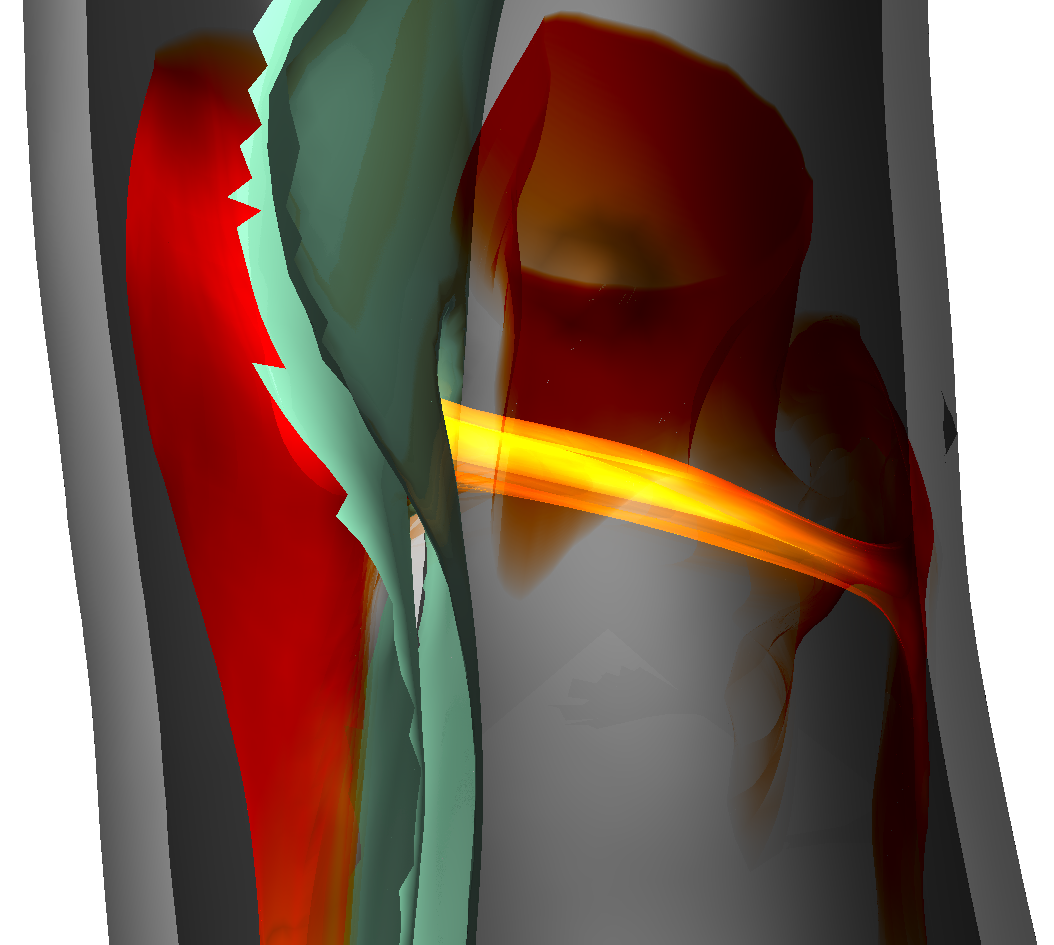
Schroeder, Aaron, Ostendorf, Kai, Bäumler, Kathrin, Mastrodicasa, Domenico, Fleischmann, Dominik, Preim, Bernhard, Theisel, Holger, Mistelbauer, Gabriel
Understanding Aortic Dissection Hemodynamics: Evaluating Adapted Smoke Surfaces Against Streakline-Based Techniques Journal Article Forthcoming
In: IEEE Transactions on Visualization and Computer Graphics (Proc. IEEE VIS 2025), vol. 33, no. 1, Forthcoming.
@article{Schroeder2025,

title = {Understanding Aortic Dissection Hemodynamics: Evaluating Adapted Smoke Surfaces Against Streakline-Based Techniques},

author = {Aaron Schroeder and Kai Ostendorf and Kathrin Bäumler and Domenico Mastrodicasa and Dominik Fleischmann and Bernhard Preim and Holger Theisel and Gabriel Mistelbauer},

url = {https://www.vismd.de/wp-content/uploads/2025/09/Schroeder2025.pdf

https://www.vismd.de/wp-content/uploads/2025/09/Schroeder2025_plots.pdf

https://www.vismd.de/wp-content/uploads/2025/09/Schroeder2025_results.xlsx},

year  = {2025},

date = {2025-11-02},

journal = {IEEE Transactions on Visualization and Computer Graphics (Proc. IEEE VIS 2025)},

volume = {33},

number = {1},

publisher = {IEEE Transactions on Visualization and Computer Graphics (Proc. IEEE VIS 2025)},

abstract = {Aortic dissection is a life-threatening cardiovascular disease characterized by blood entering the media layer of the aortic vessel wall. This creates a second flow channel, known as the false lumen, which weakens the aortic wall and can potentially lead to fatal aortic rupture. Current risk stratification of aortic dissections is primarily based on morphological features of the aorta. However, hemodynamics also play a significant role in disease progression, though their investigation and visualization remain challenging. Common flow visualizations often experience visual clutter, especially when dealing with the intricate morphologies of aortic dissections. In this work, we implement and evaluate different approaches to visualizing the flow in aortic dissections effectively. We employ three techniques, namely streaklines with depth-dependent halos, transparent streaklines, and smoke surfaces. The latter is a technique based on streak surfaces, enhanced with opacity modulations, to produce a smoke-like appearance that improves visual clarity. We adapt the original opacity modulation of smoke surfaces to visualize flow even within the complex geometries of aortic dissections, thereby enhancing visual fidelity. To effectively capture dissection hemodynamics, we developed customized seeding structures that adapt to the shape of the surrounding lumen. Our evaluation, conducted via an online questionnaire, included medical professionals, fluid simulation experts, and visualization specialists. By analyzing results across these groups, we highlight differences in preference and interpretability, offering insight into domain-specific needs. No single visualization technique emerged as the best overall. Smoke surfaces provide the best overall clarity and visual realism. However, participants found streaklines with halos to be the best for quantifying flow, dispite them introducing significant visual clutter. Transparent streaklines serve as a middle ground, offering improved clarity over halos while maintaining some level of detail. Across all participant groups, smoke surfaces were rated as the most visually appealing and lifelike, with medical professionals highlighting their resemblance to contrast-agent injections used in clinical practice.},

keywords = {},

pubstate = {forthcoming},

tppubtype = {article}

}
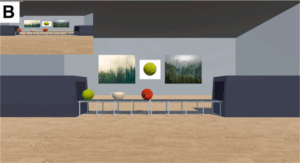
Belger, Julia, Peters, Lisa Patricia, Jakober, Jorik, Wagner, Sebastian, Preim, Bernhard, Villringer, Arno, Thoene-Otto, Angelika
Virtual reality eye movement training for neglect rehabilitation Journal Article
In: International Journal of Clinical and Health Psychology, vol. 25, no. 4, 2025.
@article{Belger2025,

title = {Virtual reality eye movement training for neglect rehabilitation},

author = {Julia Belger and Lisa Patricia Peters and Jorik Jakober and Sebastian Wagner and Bernhard Preim and Arno Villringer and Angelika Thoene-Otto},

doi = {https://doi.org/10.1016/j.ijchp.2025.100630},

year  = {2025},

date = {2025-10-15},

journal = {International Journal of Clinical and Health Psychology},

volume = {25},

number = {4},

abstract = {Background

Smooth pursuit training (SPT) is recognized as an effective intervention for spatial neglect by guiding patients’ attention toward the contralesional hemifield through repetitive tracking of moving visual stimuli. However, traditional SPT approaches lack standardized, real-time feedback on gaze and head position and patient motivation, limiting therapists' ability to monitor attention and patients' engagement effectively. Combining immersive virtual reality (VR) with eye tracking may overcome these limitations by providing immediate automated feedback, enhancing therapeutic outcomes and being associated with increased awareness of deficits.


Methods

We developed and evaluated an immersive Virtual Reality Eye Movement Training (VR-EMT) paradigm integrating eye tracking and real-time automated feedback on gaze and head orientation. Twelve chronic post-stroke patients with left-sided neglect completed 10 VR-EMT sessions (each lasting 18 min). We assessed performance in a spatially lateralized object transport task, head rotation behavior, gaze distribution, usability, and patient preferences in comparison to traditional SPT.


Results

VR-EMT was independently executable and highly accepted by patients. Real-time feedback improved patients' head orientation awareness and adjustments. Task accuracy decreased with increasing task difficulty, indicating effective demand modulation. A persistent ipsilesional gaze bias was found during breaks. Patients preferred VR-EMT over traditional SPT due to enhanced feedback, motivation, and challenge. Cybersickness was minimal and did not impair performance.


Conclusions

This feasibility study demonstrated that VR-EMT integrating eye tracking and immediate feedback is technically feasible, clinically applicable, well-accepted, and subjectively preferred over traditional methods in chronic post-stroke neglect patients. Eye tracking functioned reliably, even as the sole interaction modality. Real-time feedback facilitated rapid behavioral adjustments, highlighting the potential for individualized interventions and remote application. Future studies should evaluate clinical efficacy and the benefits of eye-tracking-based attentional assessment.},

keywords = {},

pubstate = {published},

tppubtype = {article}

}
Smooth pursuit training (SPT) is recognized as an effective intervention for spatial neglect by guiding patients’ attention toward the contralesional hemifield through repetitive tracking of moving visual stimuli. However, traditional SPT approaches lack standardized, real-time feedback on gaze and head position and patient motivation, limiting therapists' ability to monitor attention and patients' engagement effectively. Combining immersive virtual reality (VR) with eye tracking may overcome these limitations by providing immediate automated feedback, enhancing therapeutic outcomes and being associated with increased awareness of deficits.
Methods
We developed and evaluated an immersive Virtual Reality Eye Movement Training (VR-EMT) paradigm integrating eye tracking and real-time automated feedback on gaze and head orientation. Twelve chronic post-stroke patients with left-sided neglect completed 10 VR-EMT sessions (each lasting 18 min). We assessed performance in a spatially lateralized object transport task, head rotation behavior, gaze distribution, usability, and patient preferences in comparison to traditional SPT.
Results
VR-EMT was independently executable and highly accepted by patients. Real-time feedback improved patients' head orientation awareness and adjustments. Task accuracy decreased with increasing task difficulty, indicating effective demand modulation. A persistent ipsilesional gaze bias was found during breaks. Patients preferred VR-EMT over traditional SPT due to enhanced feedback, motivation, and challenge. Cybersickness was minimal and did not impair performance.
Conclusions
This feasibility study demonstrated that VR-EMT integrating eye tracking and immediate feedback is technically feasible, clinically applicable, well-accepted, and subjectively preferred over traditional methods in chronic post-stroke neglect patients. Eye tracking functioned reliably, even as the sole interaction modality. Real-time feedback facilitated rapid behavioral adjustments, highlighting the potential for individualized interventions and remote application. Future studies should evaluate clinical efficacy and the benefits of eye-tracking-based attentional assessment.
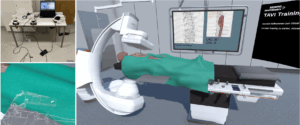
Jakober, Jorik, Kunz, Matthias, Kreher, Robert, Pantano, Matteo, Braß, Daniel, Weidling, Janine, Hansen, Christian, Braun-Dullaeus, Rüdiger, Preim, Bernhard
Design, development, and evaluation of an immersive augmented virtuality training system for transcatheter aortic valve replacement Journal Article
In: Computers & Graphics, vol. 133, 2025.
@article{Jakober2025b,

title = {Design, development, and evaluation of an immersive augmented virtuality training system for transcatheter aortic valve replacement},

author = {Jorik Jakober and Matthias Kunz and Robert Kreher and Matteo Pantano and Daniel Braß and Janine Weidling and Christian Hansen and Rüdiger Braun-Dullaeus and Bernhard Preim},

doi = {https://doi.org/10.1016/j.cag.2025.104414},

year  = {2025},

date = {2025-09-12},

journal = {Computers & Graphics},

volume = {133},

abstract = {Strong procedural skills are essential to perform safe and effective transcatheter aortic valve replacement (TAVR). Traditional training takes place in the operating room (OR) on real patients and requires learning new motor skills, resulting in longer procedure times, increased risk of complications, and greater radiation exposure for patients and medical personnel. Desktop-based simulators in interventional cardiology have shown some validity but lack true depth perception, whereas head-mounted display based Virtual Reality (VR) offers intuitive 3D interaction that enhances training effectiveness and spatial understanding. However, providing realistic and immersive training remains a challenging task as both lack tactile feedback. We have developed an augmented virtuality (AV) training system for transfemoral TAVR, combining a catheter tracking device (for translational input) with a simulated virtual OR. The system enables users to manually control a virtual angiography system via hand tracking and navigate a guidewire through a virtual patient up to the aortic valve using fluoroscopic-like imaging. In addition, we conducted a preliminary user study with 12 participants, assessing cybersickness, usability, workload, sense of presence, and qualitative factors. Preliminary results indicate that the system provides realistic interaction for key procedural steps, making it a suitable learning tool for novices. Limitations in angiography system operation include the lack of haptic resistance and usability limitations related to C-arm control, particularly due to hand tracking constraints and split attention between interaction and monitoring. Suggestions for improvement include catheter rotation tracking, expanded procedural coverage, and enhanced fluoroscopic image fidelity.},

keywords = {},

pubstate = {published},

tppubtype = {article}

}
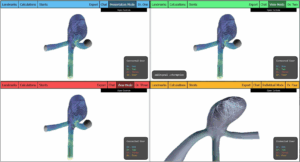
Preßler, Rebecca, Meuschke, Monique, Preim, Bernhard, Lawonn, Kai
Visualization Support for Remote Collaborative Aneurysm Treatment Planning Journal Article
In: International Journal of Computer Assisted Radiology and Surgery, 2025.
@article{Preßler2025,

title = {Visualization Support for Remote Collaborative Aneurysm Treatment Planning},

author = {Rebecca Preßler and Monique Meuschke and Bernhard Preim and Kai Lawonn},

year  = {2025},

date = {2025-08-18},

journal = {International Journal of Computer Assisted Radiology and Surgery},

keywords = {},

pubstate = {published},

tppubtype = {article}

}
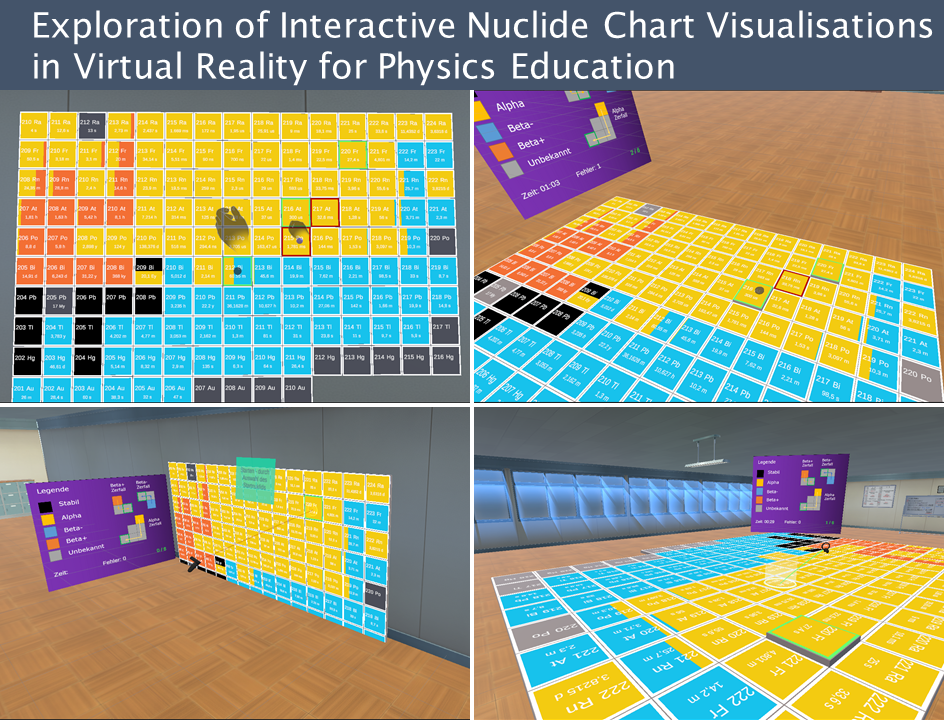
Zöllner, Janine, Preim, Bernhard, Vahlbruch, Jan-Willem, Pottgießer, Vivien, Saalfeld, Patrick
Exploration of interactive nuclide chart visualisations in virtual reality for physics education Journal Article
In: Computers & Graphics, vol. 130, no. 104258, 2025.
@article{Zoellner25,

title = {Exploration of interactive nuclide chart visualisations in virtual reality for physics education},

author = {Janine Zöllner and Bernhard Preim and Jan-Willem Vahlbruch and Vivien Pottgießer and Patrick Saalfeld},

doi = {https://doi.org/10.1016/j.cag.2025.104258},

year  = {2025},

date = {2025-08-01},

journal = {Computers & Graphics},

volume = {130},

number = {104258},

abstract = {Immersive virtual reality (VR) is used for various types of learning content. One fundamental but challenging part of VR applications are suitable interaction techniques. In this work, we use the example of interactive nuclide charts to investigate interaction techniques in VR. For this purpose, four variants of visualising an interactive nuclide chart for decay rows in a VR environment were implemented: The floor-freehand variant offers the possibility to move freely on the chart, the floor-controller variant enables teleportation to nuclides using the controller, the wall-freehand variant uses hand gestures to select nuclides, and the wall-controller variant also uses the controller to select nuclides on the wall. Our user study with 24 participants indicated that the wall-controller variant was favoured in terms of usability and user experience.},

keywords = {},

pubstate = {published},

tppubtype = {article}

}
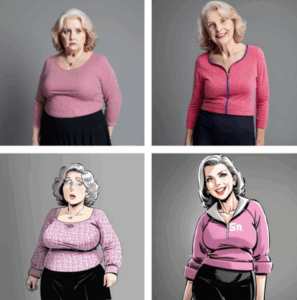
Mittenentzwei, Sarah, Garrison, Laura A, Budich, Beatrice, Lawonn, Kai, Dockhorn, Alexander, Preim, Bernhard, Meuschke, Monique
AI-based character generation for disease stories: a case study using epidemiological data to highlight preventable risk factors Journal Article
In: i-com, vol. 24, no. 1, pp. 259-281, 2025.
@article{Mittenentzwei2025,

title = {AI-based character generation for disease stories: a case study using epidemiological data to highlight preventable risk factors},

author = {Sarah Mittenentzwei and Laura A Garrison and Beatrice Budich and Kai Lawonn and Alexander Dockhorn and Bernhard Preim and Monique Meuschke},

url = {https://vis.uib.no/wp-content/papercite-data/pdfs/mittenentzwei2025icom.pdf},

doi = {https://doi.org/10.1515/icom-2024-0041},

year  = {2025},

date = {2025-04-16},

journal = {i-com},

volume = {24},

number = {1},

pages = {259-281},

abstract = {Data-driven storytelling has grown significantly, becoming prevalent in various fields, including healthcare. In medical narratives, characters are crucial for engaging audiences, making complex medical information accessible, and potentially influencing positive behavioral and lifestyle changes. However, designing characters that are both educational and relatable to effectively engage audiences is challenging. We propose a GenAI-assisted pipeline for character design in data-driven medical stories, utilizing Stable Diffusion, a deep learning text-to-image model, to transform data into visual character representations. This approach reduces the time and artistic skills required to create characters that reflect the underlying data. As a proof-of-concept, we generated and evaluated two characters in a crowd-sourced case study, assessing their authenticity to the underlying data and consistency over time. In a qualitative evaluation with four experts with knowledge in design and health communication, the characters were discussed regarding their quality and refinement opportunities. The characters effectively conveyed various aspects of the data, such as emotions, age, and body weight. However, generating multiple consistent images of the same character proved to be a significant challenge. This underscores a key issue in using generative AI for character creation: the limited control designers have over the output.},

keywords = {},

pubstate = {published},

tppubtype = {article}

}
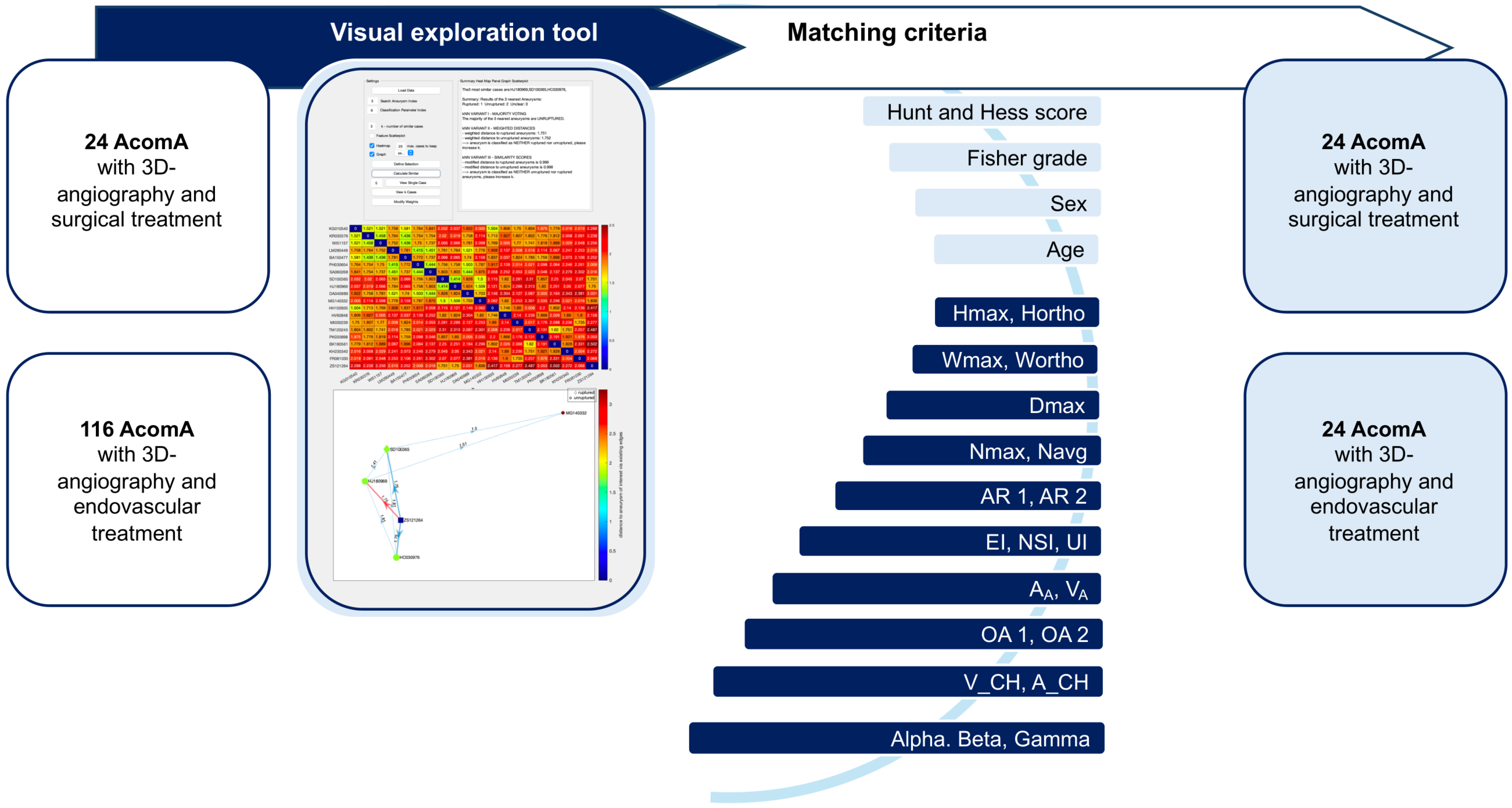
Swiatek, Vanessa M, Amini, Amir, Dumitru, Claudia A., Spitz, Lena Iam, Stein, Klaus-Peter, Saalfeld, Sylvia, Rashidi, Ali, Sandalcioglu, I. Erol, Neyazi, Belal
Multidimensional Comparison of Microsurgical Clipping and Endovascular Techniques for Anterior Communicating Artery Aneurysms: Balancing Occlusion Rates and Periprocedural Risks Journal Article
In: medicina, vol. 61, no. 3, pp. 498, 2025.
BibTeX | Links:
@article{Swiatek_2025_multidimensialClipCoil,

title = {Multidimensional Comparison of Microsurgical Clipping and Endovascular Techniques for Anterior Communicating Artery Aneurysms: Balancing Occlusion Rates and Periprocedural Risks},

author = {Vanessa M Swiatek and Amir Amini and Claudia A. Dumitru and Lena Iam Spitz and Klaus-Peter Stein and Sylvia Saalfeld and Ali Rashidi and I. Erol Sandalcioglu and Belal Neyazi},

doi = {https://doi.org/10.3390/medicina61030498},

year  = {2025},

date = {2025-03-13},

journal = {medicina},

volume = {61},

number = {3},

pages = {498},

keywords = {},

pubstate = {published},

tppubtype = {article}

}
Allgaier, Mareen, Dangszat, Eric-Morten, Huettl, Florentine, Hanke, Laura Isabel, Huber, Tobias, Preim, Bernhard, Hansen, Christian
Impact of Input and Output Devices on a Virtual Ultrasound Training Journal Article
In: 2025 IEEE Conference on Virtual Reality and 3D User Interfaces Abstracts and Workshops (VRW), pp. 937-941, 2025.
@article{Allgeier2025,

title = {Impact of Input and Output Devices on a Virtual Ultrasound Training},

author = {Mareen Allgaier and Eric-Morten Dangszat and Florentine Huettl and Laura Isabel Hanke and Tobias Huber and Bernhard Preim and Christian Hansen},

doi = {10.1109/VRW66409.2025.00191},

year  = {2025},

date = {2025-03-08},

journal = {2025 IEEE Conference on Virtual Reality and 3D User Interfaces Abstracts and Workshops (VRW)},

pages = {937-941},

abstract = {Performing ultrasound requires mental skills that have to be trained hands on. Virtual simulations can be employed to provide novice surgeons with a safe training environment prior to performing ultrasound on the patient. For both input and output there is a wide range of devices that are used in existing ultrasound simulations. Because the devices have their limitations and benefits regarding realism, costs, and access, we compared three technical setups: desktop with mouse interaction, desktop with a haptic device, and virtual reality with a haptic device. In a user study with 19 participants we investigated the usability and assessed qualitative user feedback in a semi-structured interview. Significant differences regarding usability and training time were found between both versions with the haptic device and the desktop with mouse version. Based on the feedback, using a haptic device seems to be more relevant than the two output devices in this training case.},

keywords = {},

pubstate = {published},

tppubtype = {article}

}
Kleinau, Anna, Preim, Bernhard, Meuschke, Monique
FINCH: Locally Visualizing Higher-Order Feature Interactions in Black Box Models Journal Article
In: arXiv, 2025.
@article{Kleinau2025,

title = {FINCH: Locally Visualizing Higher-Order Feature Interactions in Black Box Models},

author = {Anna Kleinau and Bernhard Preim and Monique Meuschke},

doi = { https://doi.org/10.48550/arXiv.2503.16445},

year  = {2025},

date = {2025-02-17},

journal = {arXiv},

abstract = {In an era where black-box AI models are integral to decision-making across industries, robust methods for explaining these models are more critical than ever. While these models leverage complex feature interplay for accurate predictions, most explanation methods only assign relevance to individual features. There is a research gap in methods that effectively illustrate interactions between features, especially in visualizing higher-order interactions involving multiple features, which challenge conventional representation methods. To address this challenge in local explanations focused on individual instances, we employ a visual, subset-based approach to reveal relevant feature interactions. Our visual analytics tool FINCH uses coloring and highlighting techniques to create intuitive, human-centered visualizations, and provides additional views that enable users to calibrate their trust in the model and explanations. We demonstrate FINCH in multiple case studies, demonstrating its generalizability, and conducted an extensive human study with machine learning experts to highlight its helpfulness and usability. With this approach, FINCH allows users to visualize feature interactions involving any number of features locally.},

keywords = {},

pubstate = {published},

tppubtype = {article}

}
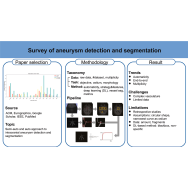
Hsu, Wei-Chan, Meuschke, Monique, Frangi, Alejandro F., Preim, Bernhard, Lawonn, Kai
A survey of intracranial aneurysm detection and segmentation Journal Article
In: Medical Image Analysis, vol. 101, 2025.
BibTeX | Links:
@article{Hsu_MIA,

title = {A survey of intracranial aneurysm detection and segmentation},

author = {Wei-Chan Hsu and Monique Meuschke and Alejandro F. Frangi and Bernhard Preim and Kai Lawonn},

editor = {Elsevier},

doi = {https://doi.org/10.1016/j.media.2025.103493},

year  = {2025},

date = {2025-02-11},

journal = {Medical Image Analysis},

volume = {101},

keywords = {},

pubstate = {published},

tppubtype = {article}

}
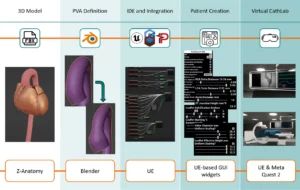
Razavizadeh, Seyedsina, Kofler, Markus, Kunz, Matthias, Kempfert, Joerg, Braun-Dullaeus, Ruediger, Weidling, Janine, Preim, Bernhard, Hansen, Christian
A virtual patient authoring tool for transcatheter aortic valve replacement Journal Article
In: International Journal of Computer Assisted Radiology and Surgery, vol. 20, no. 2, pp. 379-389, 2025.
@article{Razavizadeh2025,

title = {A virtual patient authoring tool for transcatheter aortic valve replacement},

author = {Seyedsina Razavizadeh and Markus Kofler and Matthias Kunz and Joerg Kempfert and Ruediger Braun-Dullaeus and Janine Weidling and Bernhard Preim and Christian Hansen},

doi = {https://doi.org/10.1007/s11548-024-03293-x},

year  = {2025},

date = {2025-02-01},

journal = {International Journal of Computer Assisted Radiology and Surgery},

volume = {20},

number = {2},

pages = {379-389},

abstract = {Purpose

Computer-based medical training scenarios, derived from patient’s records, often lack variability, modifiability, and availability. Furthermore, generating image datasets and creating scenarios is resource-intensive. Therefore, patient authoring tools for rapid dataset-independent creation of virtual patients (VPs) is a pressing need.


Methods

An authoring tool and a virtual catheterization laboratory environment were developed. The tool allows customised VP generation through a real-time morphable heart model and Euroscore parameters. The generated VP can be examined inside the vCathLab using a fluoroscopy and monitoring device, both on desktop and immersive virtual reality. Seven board-certified experts evaluated the proposed method from three aspects, i.e. System Usability Scale, qualitative feedback, and its performance in VR.


Results

All participants agreed that this method could provide the necessary information and is anatomically correct within an educational context. Its modifiability, variability, and simplicity were well recognised. The prototype achieved excellent usability score and considerable performance results.


Conclusion

We present a highly variable VP authoring tool that enhances variability in medical training scenarios. Although this work does not aim to explore didactic aspects, the potential of using this approach in an educational context has been confirmed in our study. Accordingly, these aspects can benefit from a thorough investigation in the future. In addition, our tool can be improved to provide more realistic parameter ranges for procedure-specific cases.},

keywords = {},

pubstate = {published},

tppubtype = {article}

}
Computer-based medical training scenarios, derived from patient’s records, often lack variability, modifiability, and availability. Furthermore, generating image datasets and creating scenarios is resource-intensive. Therefore, patient authoring tools for rapid dataset-independent creation of virtual patients (VPs) is a pressing need.
Methods
An authoring tool and a virtual catheterization laboratory environment were developed. The tool allows customised VP generation through a real-time morphable heart model and Euroscore parameters. The generated VP can be examined inside the vCathLab using a fluoroscopy and monitoring device, both on desktop and immersive virtual reality. Seven board-certified experts evaluated the proposed method from three aspects, i.e. System Usability Scale, qualitative feedback, and its performance in VR.
Results
All participants agreed that this method could provide the necessary information and is anatomically correct within an educational context. Its modifiability, variability, and simplicity were well recognised. The prototype achieved excellent usability score and considerable performance results.
Conclusion
We present a highly variable VP authoring tool that enhances variability in medical training scenarios. Although this work does not aim to explore didactic aspects, the potential of using this approach in an educational context has been confirmed in our study. Accordingly, these aspects can benefit from a thorough investigation in the future. In addition, our tool can be improved to provide more realistic parameter ranges for procedure-specific cases.
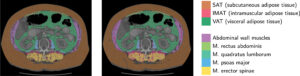
Kreher, Robert, Hille, Georg, Preim, Bernhard, Hinnerichs, Mattes, Borggrefe, Jan, Surov, Alexey, Saalfeld, Sylvia
Multilabel segmentation and analysis of skeletal muscle and adipose tissue in routine abdominal CT scans Journal Article
In: Computers in Biology and Medicine, vol. 186, 2025.
@article{Kehrer2025,

title = {Multilabel segmentation and analysis of skeletal muscle and adipose tissue in routine abdominal CT scans},

author = {Robert Kreher and Georg Hille and Bernhard Preim and Mattes Hinnerichs and Jan Borggrefe and Alexey Surov and Sylvia Saalfeld },

doi = {https://doi.org/10.1016/j.compbiomed.2024.109622},

year  = {2025},

date = {2025-01-07},

journal = {Computers in Biology and Medicine},

volume = {186},

abstract = {Purpose: This paper presents a deep learning-based multi-label segmentation network that extracts a total of

three separate adipose tissues and five different muscle tissues in CT slices of the third lumbar vertebra and

additionally improves the segmentation of the intermuscular fat.

Method: Based on a self-created data set of 130 patients, an extended Unet structure was trained and evaluated

with the help of Dice score, IoU and Pixel Accuracy. In addition, the interobserver variability for the decision

between ground truth and post-processed segmentation was calculated to illustrate the relevance in everyday

clinical practice.

Results: On average, the presented approach achieved 91.0 ± 0.065% DSC for the muscle tissues and

88.9 ± 0.062% DSC for the adipose tissues. It was shown that by post-processing the intermuscular fat tissue,

physicians prefer the result of the algorithm presented in the paper to their segmentation by 91.51%.

Conclusion: The algorithm provided more precise segmentations of muscles and adipose tissue, demonstrating

high-quality performance in segmenting muscle tissue. In qualitative evaluations, physicians preferred the

algorithm’s segmentation over expert segmentations, with the preference quantified as 91.51%. This indicates

that, based on their assessment, the algorithm’s results were significantly favored. This qualitative feedback

supports the algorithm’s use in subsequent analyses of patient fitness, leveraging the detailed information it

provides.},

keywords = {},

pubstate = {published},

tppubtype = {article}

}
three separate adipose tissues and five different muscle tissues in CT slices of the third lumbar vertebra and
additionally improves the segmentation of the intermuscular fat.
Method: Based on a self-created data set of 130 patients, an extended Unet structure was trained and evaluated
with the help of Dice score, IoU and Pixel Accuracy. In addition, the interobserver variability for the decision
between ground truth and post-processed segmentation was calculated to illustrate the relevance in everyday
clinical practice.
Results: On average, the presented approach achieved 91.0 ± 0.065% DSC for the muscle tissues and
88.9 ± 0.062% DSC for the adipose tissues. It was shown that by post-processing the intermuscular fat tissue,
physicians prefer the result of the algorithm presented in the paper to their segmentation by 91.51%.
Conclusion: The algorithm provided more precise segmentations of muscles and adipose tissue, demonstrating
high-quality performance in segmenting muscle tissue. In qualitative evaluations, physicians preferred the
algorithm’s segmentation over expert segmentations, with the preference quantified as 91.51%. This indicates
that, based on their assessment, the algorithm’s results were significantly favored. This qualitative feedback
supports the algorithm’s use in subsequent analyses of patient fitness, leveraging the detailed information it
provides.
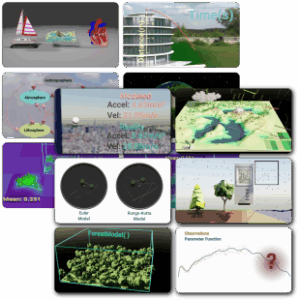
Poehls, Jeran, Meuschke, Monique, Carvalhais, Nunu, Lawonn, Kai
Either Or: Interactive Articles or Videos for Climate Science Communication Journal Article
In: COMPUTER GRAPHICS forum, vol. 44, no. 3, 2025.
@article{Poehls2025,

title = {Either Or: Interactive Articles or Videos for Climate Science Communication},

author = {Jeran Poehls and Monique Meuschke and Nunu Carvalhais and Kai Lawonn},

url = {https://vis.uni-jena.de/wp-content/uploads/2025/files/InteractiveArticlesorVideos.pdf},

year  = {2025},

date = {2025-01-01},

journal = {COMPUTER GRAPHICS forum},

volume = {44},

number = {3},

abstract = {Effective communication of climate science is critical as climate-related disasters become more frequent and severe. Translating complex information, such as uncertainties in climate model predictions, into formats accessible to diverse audiences is

key to informed decision-making and public engagement. This study investigates how different teaching formats can enhance

understanding of these uncertainties. This study compares two multimodal strategies: (1) a text-image format with interactive components and (2) an explainer video combining dynamic visuals with narration. Participants’ immediate and delayed

retention (one week) and engagement are assessed to determine which format offers greater saliency.

Sample analysis (n = 622) displayed equivalent retention by viewers between both formats. Metrics assessing interactivity

found no correlation between interactivity and information retention. However, a stark contrast was observed in the time

viewers spent engaging with each format. The video format was 29% more efficient with information taught over a period of

time vs. the article. Additionally, retention on the video format worsened with age (P = 0.004) while retention on the article

format improved with education (P = 0.038). These results align with previous findings in literature.},

keywords = {},

pubstate = {published},

tppubtype = {article}

}
key to informed decision-making and public engagement. This study investigates how different teaching formats can enhance
understanding of these uncertainties. This study compares two multimodal strategies: (1) a text-image format with interactive components and (2) an explainer video combining dynamic visuals with narration. Participants’ immediate and delayed
retention (one week) and engagement are assessed to determine which format offers greater saliency.
Sample analysis (n = 622) displayed equivalent retention by viewers between both formats. Metrics assessing interactivity
found no correlation between interactivity and information retention. However, a stark contrast was observed in the time
viewers spent engaging with each format. The video format was 29% more efficient with information taught over a period of
time vs. the article. Additionally, retention on the video format worsened with age (P = 0.004) while retention on the article
format improved with education (P = 0.038). These results align with previous findings in literature.
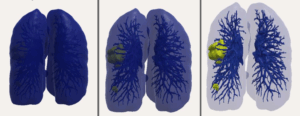
Mlitzke, Sophie, Mittenentzwei, Sarah, Preim, Bernhard, Meuschke, Monique
Interaction in Narrative Medical Visualization: Insights from a Case Study on Tumor Diseases Proceedings Article
In: Proc. of Eurographics Workshop on Visual Computing for Biology and Medicine, 2025.
BibTeX | Links:
@inproceedings{Mlitzke2025VCBM,

title = {Interaction in Narrative Medical Visualization: Insights from a Case Study on Tumor Diseases},

author = {Sophie Mlitzke and Sarah Mittenentzwei and Bernhard Preim and Monique Meuschke},

url = {https://isgwww.cs.ovgu.de/~meuschke/wp-content/uploads/2025/09/MlitzkeVCBM_2025.pdf},

year  = {2025},

date = {2025-01-01},

urldate = {2025-01-01},

booktitle = {Proc. of Eurographics Workshop on Visual Computing for Biology and Medicine},

keywords = {},

pubstate = {published},

tppubtype = {inproceedings}

}
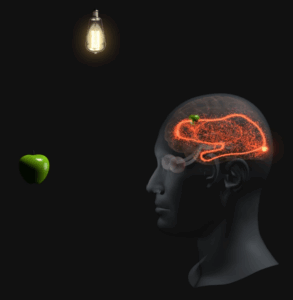
Budich, Beatrice, Preim, Bernhard, Sabel, Bernhard A, Meuschke, Monique
Narrative medical visualization to communicate vision restoration to patients: a case study Proceedings Article
In: Proc. of Eurographics Workshop on Visual Computing for Biology and Medicine, 2025.
BibTeX | Links:
@inproceedings{Budich2025VCBM,

title = {Narrative medical visualization to communicate vision restoration to patients: a case study},

author = {Beatrice Budich and Bernhard Preim and Bernhard A Sabel and Monique Meuschke},

url = {https://isgwww.cs.ovgu.de/~meuschke/wp-content/uploads/2025/09/Budich2025VCBM.pdf},

year  = {2025},

date = {2025-01-01},

urldate = {2025-01-01},

booktitle = {Proc. of Eurographics Workshop on Visual Computing for Biology and Medicine},

keywords = {},

pubstate = {published},

tppubtype = {inproceedings}

}
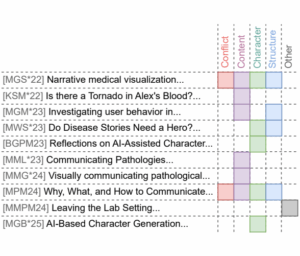
Mittenentzwei, Sarah, Mlitzke, Sophie, Budich, Beatrice, Kleinau, Anna, Preim, Bernhard, Meuschke, Monique
Visual Disease Stories: Empowering Health Literacy and Promotion Proceedings Article
In: Eurographics 2025 - Dirk Bartz Prize, The Eurographics Association, 2025.
BibTeX | Links:
@inproceedings{Mittenentzwei_2025_Bartz,

title = {Visual Disease Stories: Empowering Health Literacy and Promotion},

author = {Sarah Mittenentzwei and Sophie Mlitzke and Beatrice Budich and Anna Kleinau and Bernhard Preim and Monique Meuschke},

url = {https://diglib.eg.org/items/8148fd9e-55cc-4403-80a3-eb4bf800b10a},

doi = {https://doi.org/10.2312/evm.20251972},

year  = {2025},

date = {2025-01-01},

urldate = {2025-01-01},

booktitle = {Eurographics 2025 - Dirk Bartz Prize},

publisher = {The Eurographics Association},

keywords = {},

pubstate = {published},

tppubtype = {inproceedings}

}
2024
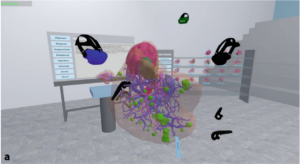
Huber, Tobias, Huettl, Florentine, Vradelis, Lukas, Tripke, Verena, Schott, Danny, Chheang, Vuthea, Saalfeld, Patrick, Allgaier, Mareen, Saalfeld, Sylvia, Preim, Bernhard, Hansen, Christian, Hanke, Laura Isabel, Lang, Hauke
Virtual Reality in der Leberchirurgie – Planen, Weiterbilden, Prüfen Journal Article
In: Die Chirurgie, 2024.
@article{Huber2024,

title = {Virtual Reality in der Leberchirurgie – Planen, Weiterbilden, Prüfen},

author = {Tobias Huber and Florentine Huettl and Lukas Vradelis and Verena Tripke and Danny Schott and Vuthea Chheang and Patrick Saalfeld and Mareen Allgaier and Sylvia Saalfeld and Bernhard Preim and Christian Hansen and Laura Isabel Hanke and Hauke Lang},

doi = {https://doi.org/10.1007/s00104-024-02216-5},

year  = {2024},

date = {2024-12-17},

journal = {Die Chirurgie},

abstract = {Bereits seit über 20 Jahren können anatomische Strukturen der Leber aus präoperativen Schnittbildgebungen dreidimensional rekonstruiert werden. Diese dreidimensionale (3D) Darstellung optimiert nicht nur die präoperativen Planungsmöglichkeiten, auch die Vermittlung spezifischer, operationsrelevanter Strukturen kann durch 3D-Modelle verbessert werden. Die disruptive Technologie der virtuellen Realität (VR) kann neben einer plastischen und interaktiven Visualisierung dreidimensionaler Organmodelle auch eine Möglichkeit zur strukturierten Aus- und Weiterbildung hinsichtlich leberchirurgischer Anatomie und Operationsplanung liefern. Prüfungen in virtueller Realität erscheinen dadurch ebenfalls greifbar. Neueste Prototypen ermöglichen sogar eine patientenindividuelle Simulation der intraoperativen Sonographie. Dieser Artikel stellt einen Überblick über den gegenwärtigen Stand der verfügbaren Technologien für Aus- und Weiterbildung mittels VR am Beispiel der Leberchirurgie dar.},

keywords = {},

pubstate = {published},

tppubtype = {article}

}
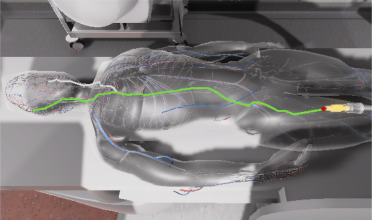
Streuber, Marcus, Allgaier, Mareen, Schwab, Roland, Behme, Daniel, Saalfeld, Sylvia
A VR neurointerventional setup for catheter-based interventions focusing on visualizing the risk of radiation Journal Article
In: Computers in Biology and Medicine, vol. 183, pp. 109224, 2024, ISSN: 0010-4825.
BibTeX | Links:
@article{Streuber2024,

title = {A VR neurointerventional setup for catheter-based interventions focusing on visualizing the risk of radiation},

author = {Marcus Streuber and Mareen Allgaier and Roland Schwab and Daniel Behme and Sylvia Saalfeld},

url = {https://www.vismd.de/wp-content/uploads/2025/12/1-s2.0-S001048252401309X-main.pdf},

doi = {10.1016/j.compbiomed.2024.109224},

issn = {0010-4825},

year  = {2024},

date = {2024-10-19},

journal = {Computers in Biology and Medicine},

volume = {183},

pages = {109224},

keywords = {},

pubstate = {published},

tppubtype = {article}

}
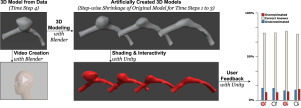
Mittenentzwei, Sarah, Mlitzke, Sophie, Grisanova, Darija, Lawonn, Kai, Preim, Bernhard, Meuschke, Monique
Visually communicating pathological changes: A case study on the effectiveness of phong versus outline shading Journal Article
In: Computers & Graphics 2024, 2024.
BibTeX | Links:
@article{Mittenentzwei2024c,

title = {Visually communicating pathological changes: A case study on the effectiveness of phong versus outline shading},

author = {Sarah Mittenentzwei and Sophie Mlitzke and Darija Grisanova and Kai Lawonn and Bernhard Preim and Monique Meuschke},

url = {https://www.sciencedirect.com/science/article/pii/S0097849324001584?via%3Dihub},

doi = {https://doi.org/10.1016/j.cag.2024.104023},

year  = {2024},

date = {2024-10-01},

journal = {Computers & Graphics 2024},

keywords = {},

pubstate = {published},

tppubtype = {article}

}
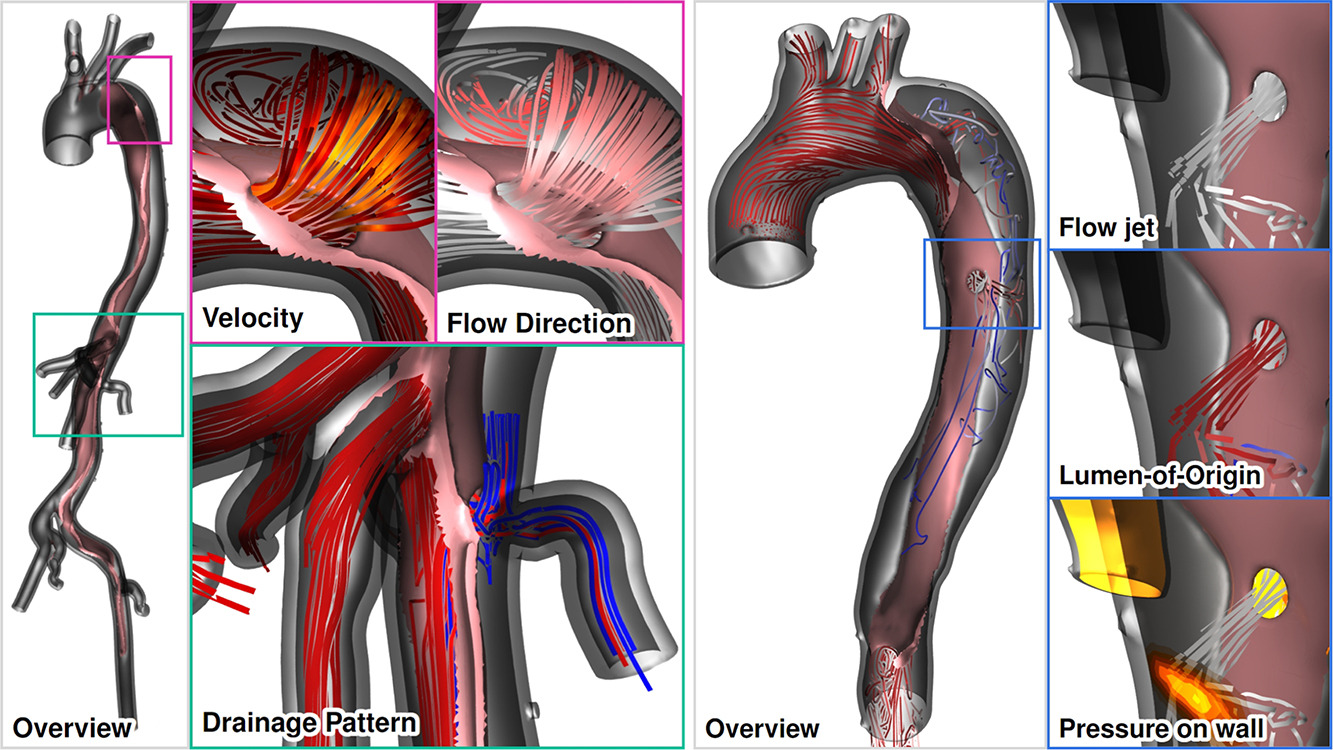
Schroeder, Aaron, Ostendorf, Kai, Bäumler, Kathrin, Mastrodicasa, Domenico, Sandfort, Veit, Fleischmann, Dominik, Preim, Bernhard, Mistelbauer, Gabriel
Advanced visualization of aortic dissection anatomy and hemodynamics Journal Article
In: Computers & Graphics 2024, vol. 124, pp. 104060, 2024, ISSN: 0097-8493.
@article{Schroeder2024,

title = {Advanced visualization of aortic dissection anatomy and hemodynamics},

author = {Aaron Schroeder and Kai Ostendorf and Kathrin Bäumler and Domenico Mastrodicasa and Veit Sandfort and Dominik Fleischmann and Bernhard Preim and Gabriel Mistelbauer},

url = {https://www.sciencedirect.com/science/article/pii/S009784932400195X

https://www.vismd.de/wp-content/uploads/2025/12/1-s2.0-S009784932400195X-main.pdf},

doi = {https://doi.org/10.1016/j.cag.2024.104060},

issn = {0097-8493},

year  = {2024},

date = {2024-10-01},

journal = {Computers & Graphics 2024},

volume = {124},

pages = {104060},

abstract = {Aortic dissection is a life-threatening cardiovascular disease constituted by the delamination of the aortic wall. Due to the weakened structure of the false lumen, the aorta often dilates over time, which can – after certain diameter thresholds are reached – increase the risk of fatal aortic rupture. The identification of patients with a high risk of late adverse events is an ongoing clinical challenge, further complicated by the complex dissection anatomy and the wide variety among patients. Moreover, patient-specific risk stratification depends not only on morphological, but also on hemodynamic factors, which can be derived from computer simulations or 4D flow magnetic resonance imaging (MRI). However, comprehensible visualizations that depict the complex anatomical and functional information in a single view are yet to be developed. These visualization tools will assist clinical research and decision-making by facilitating a comprehensive understanding of the aortic state. For that purpose, we identified several visualization tasks and requirements in close collaboration with cardiovascular imaging scientists and radiologists. We displayed true and false lumen hemodynamics using pathlines as well as surface hemodynamics on the dissection flap and the inner vessel wall. Pathlines indicate antegrade and retrograde flow, blood flow through fenestrations, and branch vessel supply. Dissection-specific hemodynamic measures, such as interluminal pressure difference and flap compliance, provide further insight of the blood flow throughout the cardiac cycle. Finally, we evaluated our visualization techniques with cardiothoracic and vascular surgeons in two separate virtual sessions.},

keywords = {},

pubstate = {published},

tppubtype = {article}

}
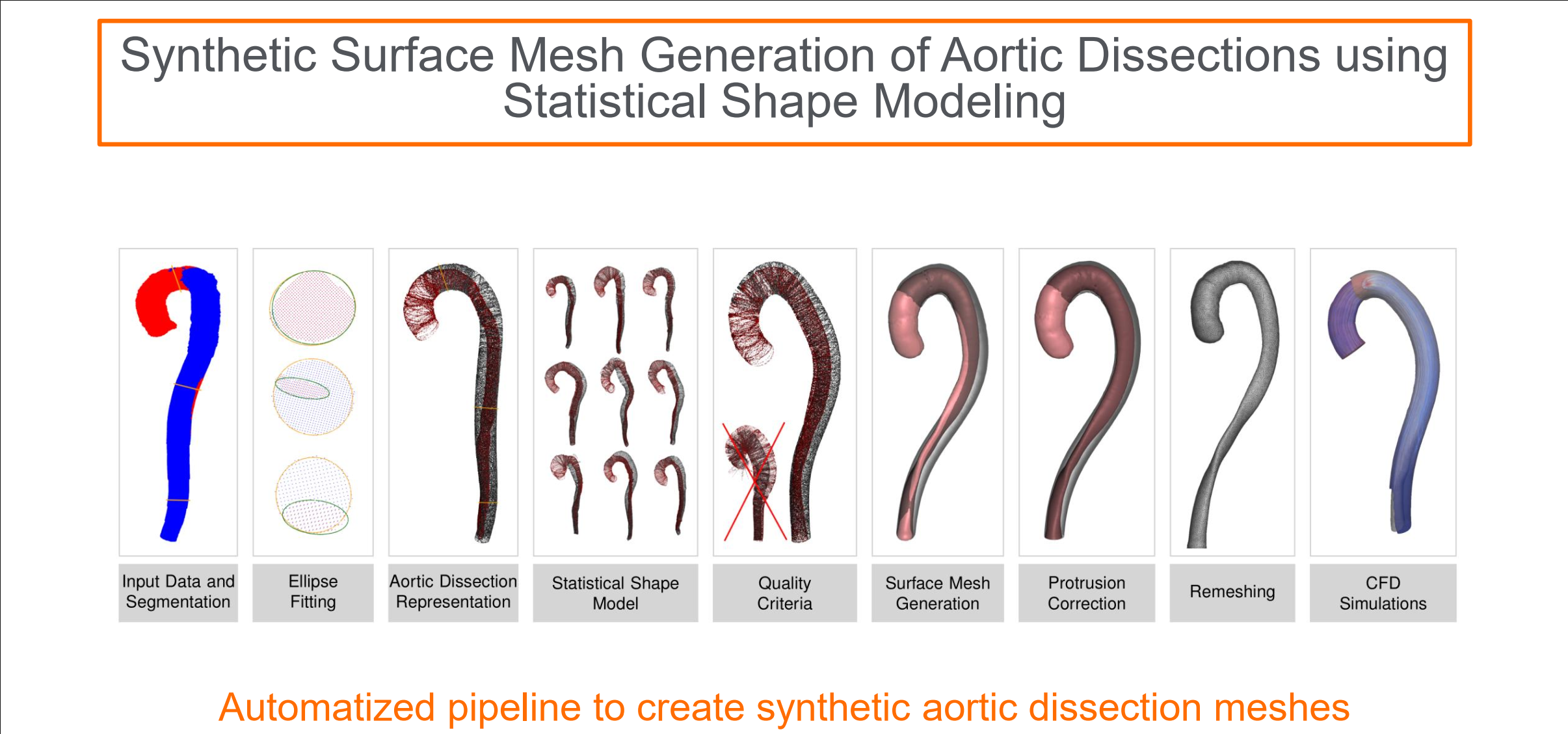
Ostendorf, Kai, Bäumler, Kathrin, Mastrodicasa, Domenico, Fleischmann, Dominik, Preim, Bernhard, Mistelbauer, Gabriel
Synthetic surface mesh generation of aortic dissections using statistical shape modeling Journal Article
In: Computers & Graphics 2024, vol. 124, pp. 104070, 2024, ISSN: 0097-8493.
@article{Ostendorf2024,

title = {Synthetic surface mesh generation of aortic dissections using statistical shape modeling},

author = {Kai Ostendorf and Kathrin Bäumler and Domenico Mastrodicasa and Dominik Fleischmann and Bernhard Preim and Gabriel Mistelbauer},

url = {https://www.sciencedirect.com/science/article/pii/S009784932400205X

https://www.vismd.de/wp-content/uploads/2025/12/1-s2.0-S009784932400205X-main.pdf},

doi = {https://doi.org/10.1016/j.cag.2024.104070},

issn = {0097-8493},

year  = {2024},

date = {2024-10-01},

journal = {Computers & Graphics 2024},

volume = {124},

pages = {104070},

abstract = {Aortic dissection is a rare disease affecting the aortic wall layers splitting the aortic lumen into two flow channels: the true and false lumen. The rarity of the disease leads to a sparsity of available datasets resulting in a low amount of available training data for in-silico studies or the training of machine learning algorithms. To mitigate this issue, we use statistical shape modeling to create a database of Stanford type B dissection surface meshes. We account for the complex disease anatomy by modeling two separate flow channels in the aorta, the true and false lumen. Former approaches mainly modeled the aortic arch including its branches but not two separate flow channels inside the aorta. To our knowledge, our approach is the first to attempt generating synthetic aortic dissection surface meshes. For the statistical shape model, the aorta is parameterized using the centerlines of the respective lumen and the according ellipses describing the cross-section of the lumen while being aligned along the centerline employing rotation-minimizing frames. To evaluate our approach we introduce disease-specific quality criteria by investigating the torsion and twist of the true lumen.},

keywords = {},

pubstate = {published},

tppubtype = {article}

}

Swiatek, Vanessa M, Amini, Amir, Marinescu, Michelle, Dumitru, Claudia A., Spitz, Lena Iam, Stein, Klaus-Peter, Saalfeld, Sylvia, Rashidi, Ali, Sandalcioglu, I. Erol, Neyazi, Belal
Sex Differences in Intracranial Aneurysms: A Matched Cohort Study Journal Article
In: Journal of Personalized Medicine, vol. 14, no. 10, pp. 1038, 2024.
BibTeX | Links:
@article{Swiatek_JPersMed2024,

title = {Sex Differences in Intracranial Aneurysms: A Matched Cohort Study},

author = {Vanessa M Swiatek and Amir Amini and Michelle Marinescu and Claudia A. Dumitru and Lena Iam Spitz and Klaus-Peter Stein and Sylvia Saalfeld and Ali Rashidi and I. Erol Sandalcioglu and Belal Neyazi},

doi = {https://doi.org/10.3390/jpm14101038},

year  = {2024},

date = {2024-09-28},

journal = {Journal of Personalized Medicine},

volume = {14},

number = {10},

pages = {1038},

keywords = {},

pubstate = {published},

tppubtype = {article}

}
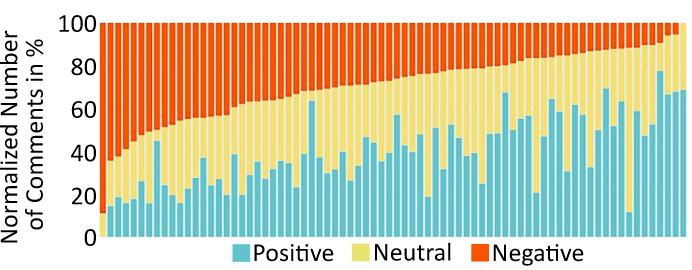
Mittenentzwei, Sarah, Murad, Danish, Preim, Bernhard, Meuschke, Monique
Leaving the Lab Setting: What We Can Learn About the Perception of Narrative Medical Visualizations from YouTube Comments Proceedings Article
In: Visual Computing for Biology and Medicine, 2024, 2024.
BibTeX | Links:
@inproceedings{Mittenentzwei2024,

title = {Leaving the Lab Setting: What We Can Learn About the Perception of Narrative Medical Visualizations from YouTube Comments},

author = {Sarah Mittenentzwei and Danish Murad and Bernhard Preim and Monique Meuschke},

url = {https://diglib.eg.org/server/api/core/bitstreams/638591a4-87e2-4017-af5d-06ecc81d783a/content

https://www.vismd.de/wp-content/uploads/2025/12/sarah_vcbm20241193.pdf},

doi = {https://doi.org/10.2312/vcbm.20241193},

year  = {2024},

date = {2024-09-20},

booktitle = {Visual Computing for Biology and Medicine, 2024},

keywords = {},

pubstate = {published},

tppubtype = {inproceedings}

}
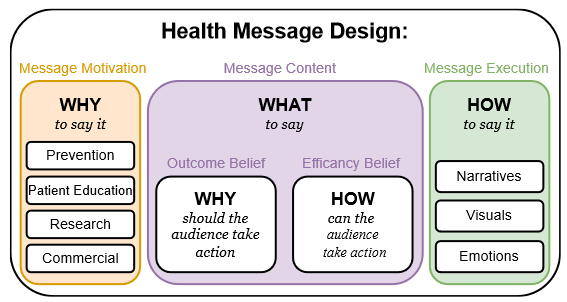
Mittenentzwei, Sarah, Preim, Bernhard, Meuschke, Monique
Why, What, and How to Communicate Health Information Visually: Reflections on the Design Process of Narrative Medical Visualization Proceedings Article
In: Visual Computing for Biology and Medicine, 2024, 2024.
BibTeX | Links:
@inproceedings{Mittenentzwei2024b,

title = {Why, What, and How to Communicate Health Information Visually: Reflections on the Design Process of Narrative Medical Visualization},

author = {Sarah Mittenentzwei and Bernhard Preim and Monique Meuschke},

url = {https://diglib.eg.org/server/api/core/bitstreams/7b0308eb-c59f-436f-bb79-96037b7d508a/content

https://www.vismd.de/wp-content/uploads/2025/12/sarah_why_what_vcbm20241192.pdf},

doi = {https://doi.org/10.2312/vcbm.20241192},

year  = {2024},

date = {2024-09-20},

booktitle = {Visual Computing for Biology and Medicine, 2024},

keywords = {},

pubstate = {published},

tppubtype = {inproceedings}

}
Härtel, Tim, Allgaier, Mareen, Behme, Daniel, Preim, Bernhard, Saalfeld, Sylvia
Virtual Reality Training for Inner Ear Anatomy Using Gamification Proceedings Article
In: Visual Computing for Biology and Medicine, 2024.
@inproceedings{Haertel25,

title = {Virtual Reality Training for Inner Ear Anatomy Using Gamification},

author = {Tim Härtel and Mareen Allgaier and Daniel Behme and Bernhard Preim and Sylvia Saalfeld},

year  = {2024},

date = {2024-09-20},

booktitle = {Visual Computing for Biology and Medicine},

keywords = {},

pubstate = {published},

tppubtype = {inproceedings}

}
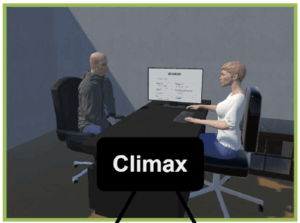
Maienschein, Theresa, Allgaier, Mareen, Huettl, Florentine, Huber, Tobias, Preim, Bernhard, Meuschke, Monique
Virtual Tales: Narrative Virtual Reality for Patient Education Proceedings Article
In: Visual Computing for Biology and Medicine, 2024.
BibTeX | Links:
@inproceedings{Maienschein24,

title = {Virtual Tales: Narrative Virtual Reality for Patient Education},

author = {Theresa Maienschein and Mareen Allgaier and Florentine Huettl and Tobias Huber and Bernhard Preim and Monique Meuschke},

url = {https://www.vismd.de/wp-content/uploads/2025/09/Maienschein_VCBM2024.pdf},

year  = {2024},

date = {2024-09-20},

booktitle = {Visual Computing for Biology and Medicine},

journal = {Visual Computing for Biology and Medicine},

keywords = {},

pubstate = {published},

tppubtype = {inproceedings}

}
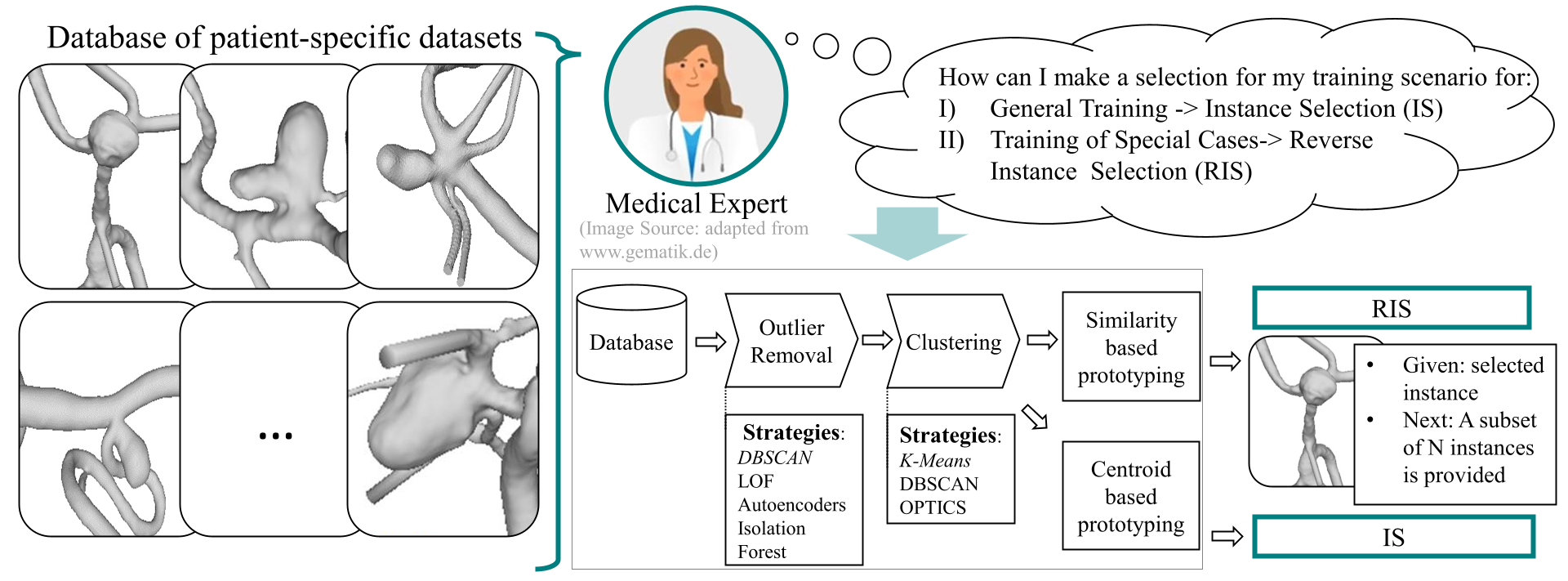
Spitz, Lena Iam, Umeh, Stanley Chukwuemeka, Behme, Daniel, Neyazi, Belal, Sandalcioglu, I. Erol, Preim, Bernhard, Saalfeld, Sylvia
Subset selection for intracranial aneurysms for training simulations Journal Article
In: Current Directions in Biomedical Engineering , vol. 10, no. 1, pp. 73-76, 2024.
BibTeX | Links:
@article{Spitz_2024_CURACb,

title = {Subset selection for intracranial aneurysms for training simulations},

author = {Lena Iam Spitz and Stanley Chukwuemeka Umeh and Daniel Behme and Belal Neyazi and I. Erol Sandalcioglu and Bernhard Preim and Sylvia Saalfeld },

url = {https://www.vismd.de/wp-content/uploads/2025/12/spitz_10.1515_cdbme-2024-0119.pdf},

doi = {https://doi.org/10.1515/cdbme-2024-0119},

year  = {2024},

date = {2024-09-12},

journal = {Current Directions in Biomedical Engineering },

volume = {10},

number = {1},

pages = {73-76},

keywords = {},

pubstate = {published},

tppubtype = {article}

}
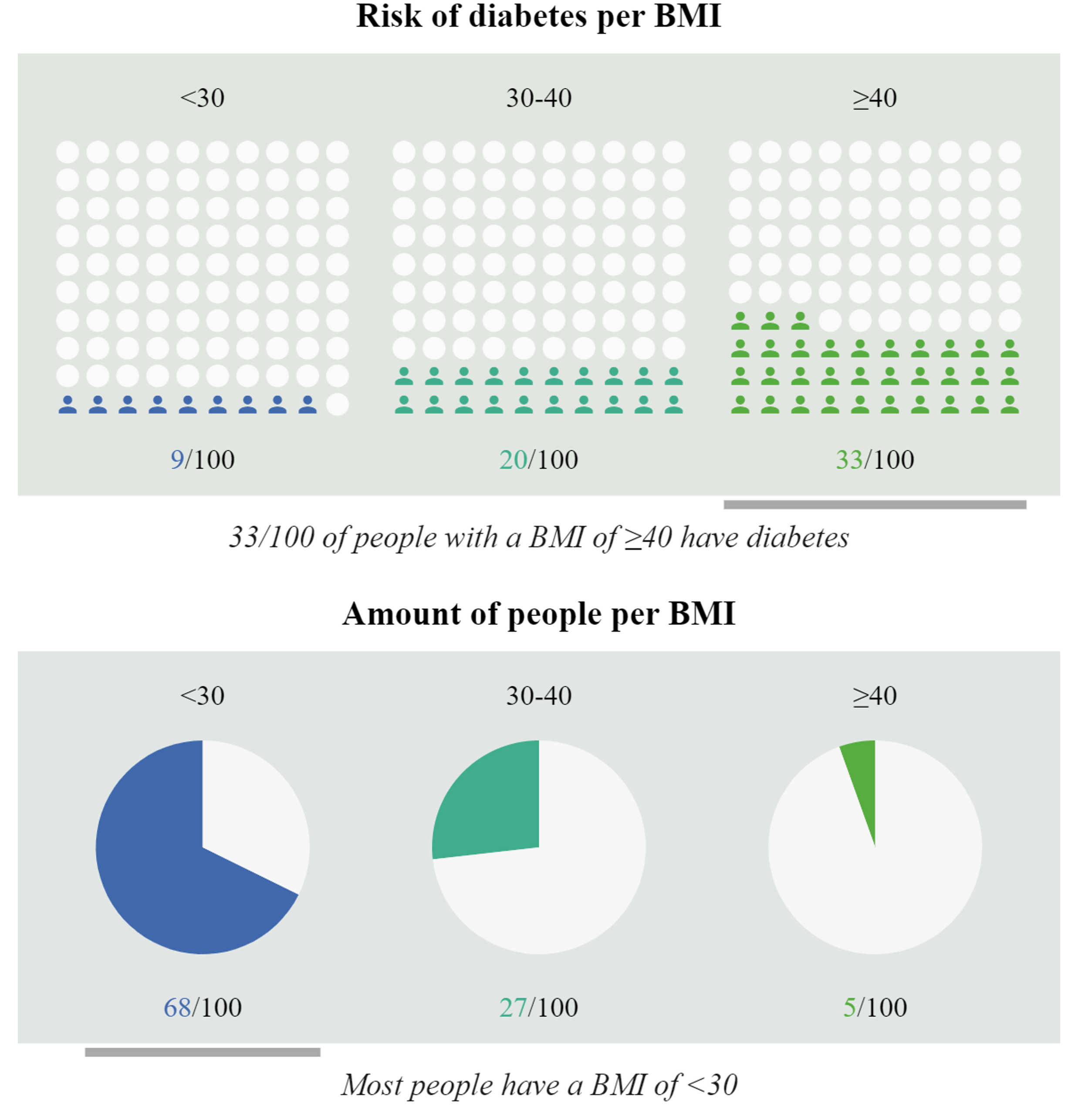
Kleinau, Anna, Preim, Bernhard, Meuschke, Monique
Raccoon: Supporting Risk Communicators in Visualizing Health Data for the Public Proceedings Article
In: Vision, Modeling, and Visualization, The Eurographics Association, 2024, ISBN: 978-3-03868-247-9.
BibTeX | Links:
@inproceedings{Kleinau2024,

title = {Raccoon: Supporting Risk Communicators in Visualizing Health Data for the Public},

author = {Anna Kleinau and Bernhard Preim and Monique Meuschke},

url = {https://www.vismd.de/wp-content/uploads/2025/12/ANNA_vmv20241200.pdf},

doi = {10.2312/vmv.20241200},

isbn = {978-3-03868-247-9},

year  = {2024},

date = {2024-09-12},

booktitle = {Vision, Modeling, and Visualization},

publisher = {The Eurographics Association},

keywords = {},

pubstate = {published},

tppubtype = {inproceedings}

}

Spitz, Lena Iam, Schmidt, Jessica, Korte, Jana, Berg, Philipp, Behme, Daniel, Neyazi, Belal, Preim, Bernhard, Saalfeld, Sylvia
Morphologic and hemodynamic analysis of intracranial mirror aneurysms Journal Article
In: Current Directions in Biomedical Engineering , vol. 10, no. 2, pp. 87-90, 2024.
BibTeX | Links:
@article{Spitz_2023_CURACb,

title = {Morphologic and hemodynamic analysis of intracranial mirror aneurysms},

author = {Lena Iam Spitz and Jessica Schmidt and Jana Korte and Philipp Berg and Daniel Behme and Belal Neyazi and Bernhard Preim and Sylvia Saalfeld},

doi = {https://doi.org/10.1515/cdbme-2024-1074},

year  = {2024},

date = {2024-09-10},

journal = { Current Directions in Biomedical Engineering },

volume = {10},

number = {2},

pages = {87-90},

keywords = {},

pubstate = {published},

tppubtype = {article}

}
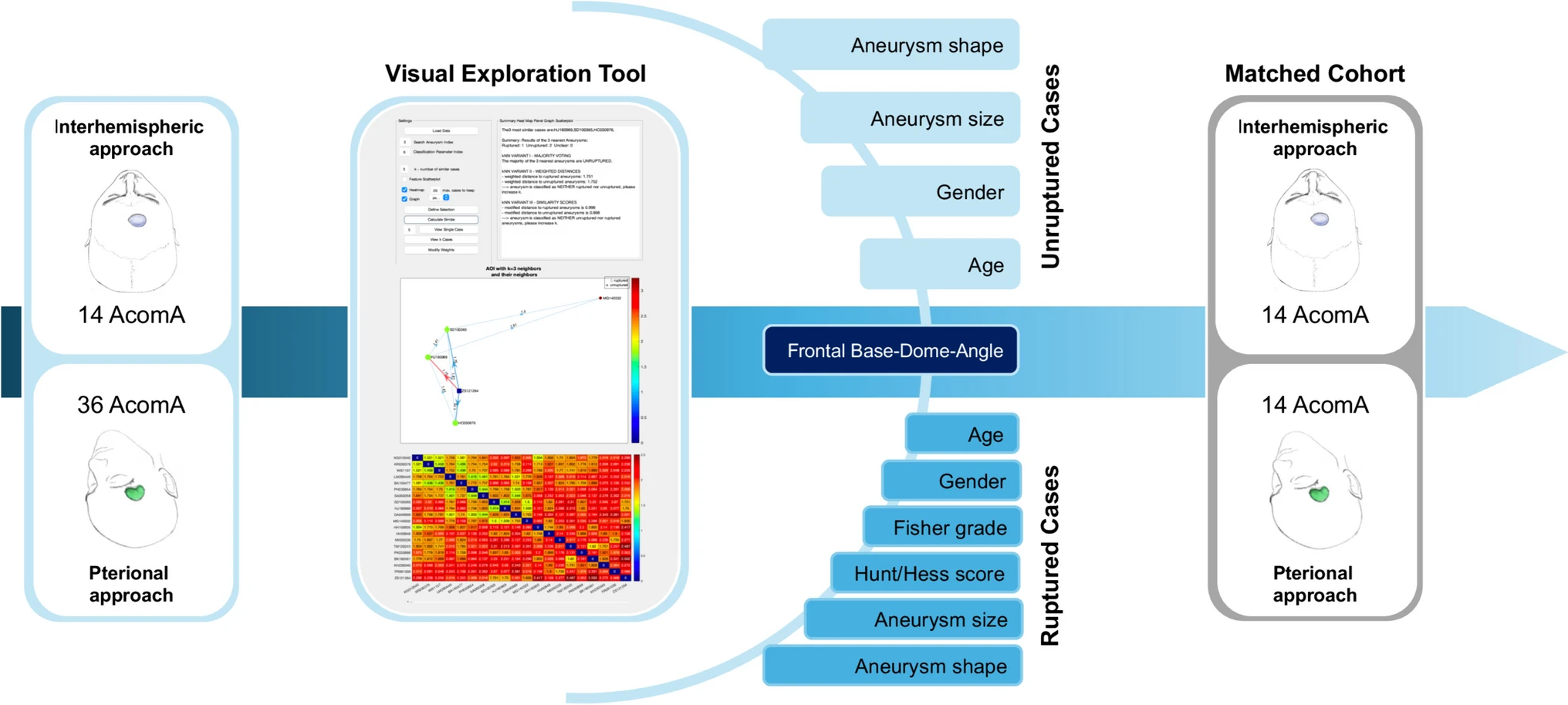
Swiatek, Vanessa M, Amini, Amir, Spitz, Lena Iam, Rashidi, Ali, Dumitru, Claudia A., Stein, Klaus-Peter, Sylvia, Saalfeld,, Sandalcioglu, I. Erol, Neyazi, Belal
Anterior interhemispheric vs. pterional approach in the microsurgical management of anterior communicating artery aneurysms: a comparative analysis employing a novel multidimensional matching-tool Journal Article
In: Neurosurgical Review, vol. 47, no. 366, 2024.
BibTeX | Links:
@article{SwiatekNeurosurgReview2024,

title = {Anterior interhemispheric vs. pterional approach in the microsurgical management of anterior communicating artery aneurysms: a comparative analysis employing a novel multidimensional matching-tool},

author = {Vanessa M Swiatek and Amir Amini and Lena Iam Spitz and Ali Rashidi and Claudia A. Dumitru and Klaus-Peter Stein and Saalfeld, Sylvia and I. Erol Sandalcioglu and Belal Neyazi},

doi = {https://doi.org/10.1007/s10143-024-02592-w},

year  = {2024},

date = {2024-07-29},

journal = {Neurosurgical Review},

volume = {47},

number = {366},

keywords = {},

pubstate = {published},

tppubtype = {article}

}
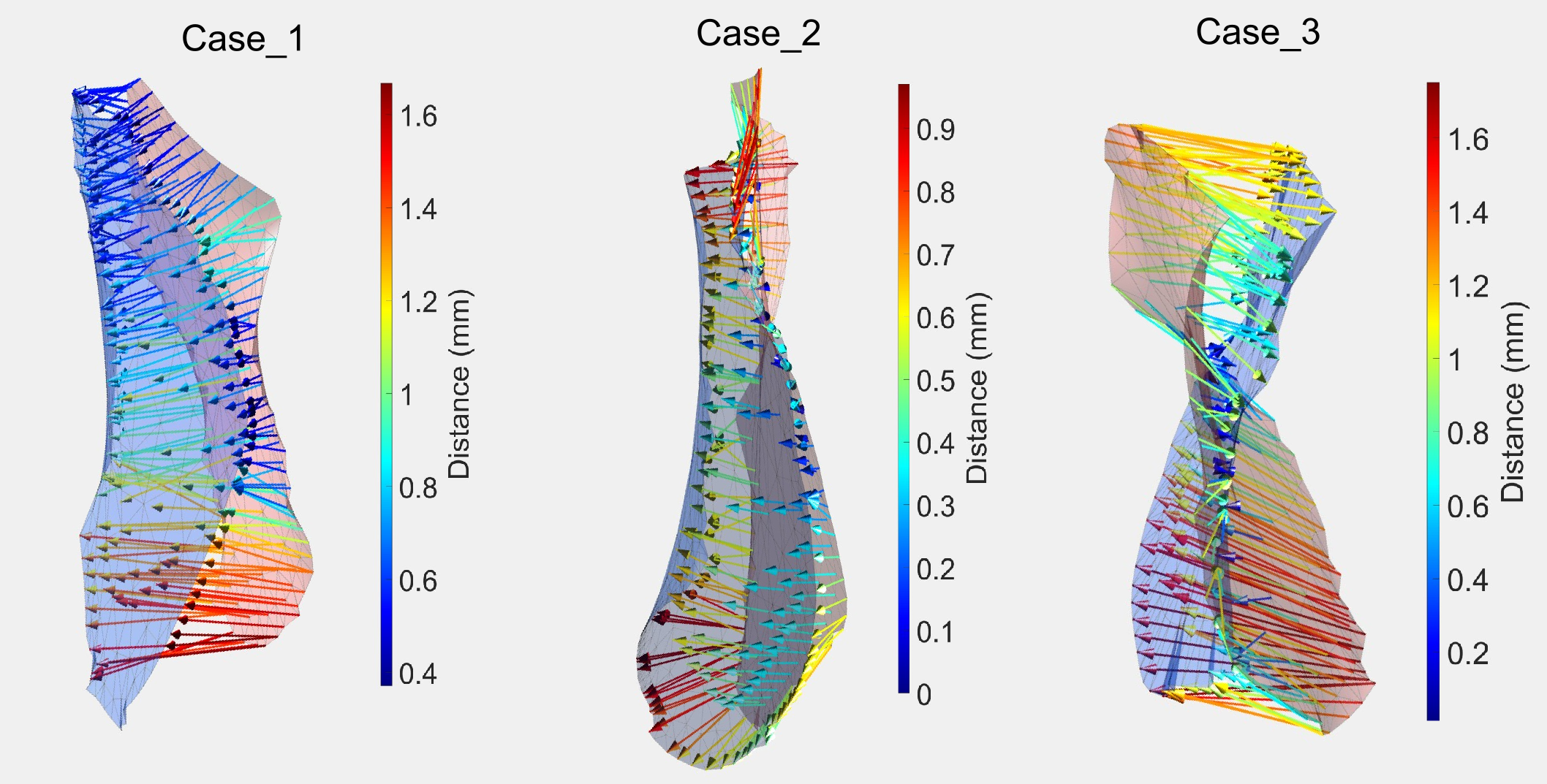
Spitz, Lena Iam, Korte, Jana, Gaidzik, Franziska, Larsen, Naomi, Preim, Bernhard, Saalfeld, Sylvia
Assessment of intracranial aneurysm neck deformation after contour deployment Journal Article
In: International Journal of Computer Assisted Radiology and Surgery, 2024.
BibTeX | Links:
@article{SpitzIJCARS2024,

title = {Assessment of intracranial aneurysm neck deformation after contour deployment},

author = {Lena Iam Spitz and Jana Korte and Franziska Gaidzik and Naomi Larsen and Bernhard Preim and Sylvia Saalfeld},

doi = {https://doi.org/10.1007/s11548-024-03189-w},

year  = {2024},

date = {2024-05-31},

journal = {International Journal of Computer Assisted Radiology and Surgery},

keywords = {},

pubstate = {published},

tppubtype = {article}

}
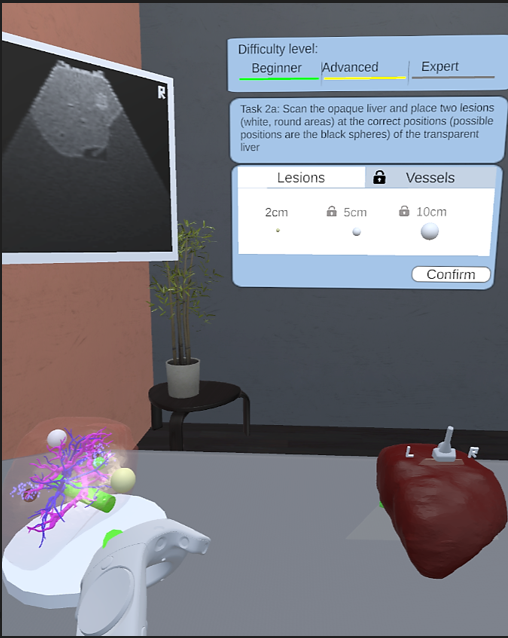
Allgaier, Mareen, Huettl, Florentine, Hanka, L., Huber, Tobias, Preim, Bernhard, Saalfeld, Sylvia, Hansen, Christian
Gamification Concepts for a VR-based Visuospatial Training for Intraoperative Liver Ultrasound Proceedings Article
In: Extended Abstracts of the CHI Conference on Human Factors in Computing Systems , Association for Computing Machinery, 2024, ISBN: 9798400703317.
BibTeX | Links:
@inproceedings{Allgaier_2024_CHI,

title = {Gamification Concepts for a VR-based Visuospatial Training for Intraoperative Liver Ultrasound},

author = {Mareen Allgaier and Florentine Huettl and L. Hanka and Tobias Huber and Bernhard Preim and Sylvia Saalfeld and Christian Hansen},

doi = {10.1145/3613905.3650736 },

isbn = {9798400703317},

year  = {2024},

date = {2024-05-15},

booktitle = {Extended Abstracts of the CHI Conference on Human Factors in Computing Systems },

number = {175},

publisher = {Association for Computing Machinery},

series = {CHI EA '24},

keywords = {},

pubstate = {published},

tppubtype = {inproceedings}

}
Belger, Julia, Wagner, Sebastian, Gaebler, Michael, Karnath, Hans-Otto, Preim, Bernhard, Saalfeld, Patrick, Schatz, Anna, Villringer, Arno, Thöne-Otto, Angelika
Application of immersive virtual reality for assessing chronic neglect in individuals with stroke: the immersive virtual road-crossing task Journal Article
In: JOURNAL OF CLINICAL AND EXPERIMENTAL NEUROPSYCHOLOGY , pp. 1-18, 2024.
BibTeX | Links:
@article{Belger_2024,

title = {Application of immersive virtual reality for assessing chronic neglect in individuals with stroke: the immersive virtual road-crossing task },

author = {Julia Belger and Sebastian Wagner and Michael Gaebler and Hans-Otto Karnath and Bernhard Preim and Patrick Saalfeld and Anna Schatz and Arno Villringer and Angelika Thöne-Otto},

doi = {10.1080/13803395.2024.2329380 },

year  = {2024},

date = {2024-03-25},

journal = {JOURNAL OF CLINICAL AND EXPERIMENTAL NEUROPSYCHOLOGY },

pages = {1-18},

keywords = {},

pubstate = {published},

tppubtype = {article}

}
Kreher, Robert, Chitti, Naveeth Reddy, Hille, Georg, Hürtgen, Janine, Mengonie, Miriam, Braun, Andreas, Tüting, Thomas, Preim, Bernhard, Saalfeld, Sylvia
Advanced Deep Learning for Skin Histoglyphics at Cellular Level Proceedings Article
In: BVM 2024: Bildverarbeitung für die Medizin 2024, pp. 66-71, Springer Verlag, 2024.
BibTeX | Links:
@inproceedings{Kreher_BVM_2024,

title = {Advanced Deep Learning for Skin Histoglyphics at Cellular Level},

author = {Robert Kreher and Naveeth Reddy Chitti and Georg Hille and Janine Hürtgen and Miriam Mengonie and Andreas Braun and Thomas Tüting and Bernhard Preim and Sylvia Saalfeld },

doi = {https://doi.org/10.1007/978-3-658-44037-4_20},

year  = {2024},

date = {2024-02-20},

booktitle = {BVM 2024: Bildverarbeitung für die Medizin 2024},

pages = {66-71},

publisher = {Springer Verlag},

keywords = {},

pubstate = {published},

tppubtype = {inproceedings}

}
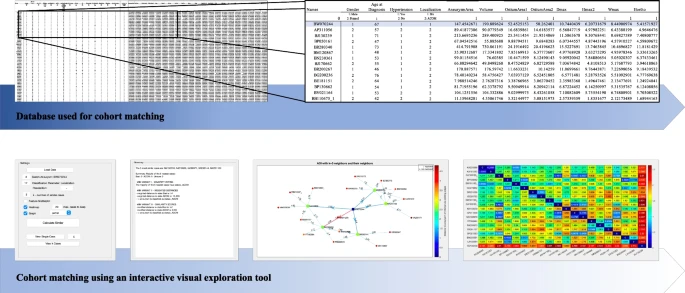
Swiatek, Vanessa M, Amini, Amir, Ortuño, Celina E. Sandalcioglu, Spitz, Lena Iam, Hartmann, Karl, Rashidi, Ali, Stein, Klaus-Peter, Sylvia, Saalfeld,, Sandalcioglu, I. Erol, Neyazi, Belal
Unveiling rupture risk and clinical outcomes in midline aneurysms: A matched cohort analysis investigating the impact of localization within the anterior or posterior circulation Journal Article
In: Neurosurgical Review, vol. 47, no. 76, 2024.
BibTeX | Links:
@article{Swiatek2024,

title = {Unveiling rupture risk and clinical outcomes in midline aneurysms: A matched cohort analysis investigating the impact of localization within the anterior or posterior circulation},

author = {Vanessa M Swiatek and Amir Amini and Celina E. Sandalcioglu Ortuño and Lena Iam Spitz and Karl Hartmann and Ali Rashidi and Klaus-Peter Stein and Saalfeld, Sylvia and I. Erol Sandalcioglu and Belal Neyazi},

doi = {http://dx.doi.org/10.1007/s10143-024-02310-6},

year  = {2024},

date = {2024-02-07},

journal = {Neurosurgical Review},

volume = {47},

number = {76},

keywords = {},

pubstate = {published},

tppubtype = {article}

}
Chheang, Vuthea, Saalfeld, Patrick, Joeres, Fabian, Boedecker, Christian, Huber, Tobias, Huettl, Florentine, Lang, Hauke, Preima, Bernhard, Hansen, Christian
A collaborative virtual reality environment for liver surgery planning Journal Article
In: Computers & Graphics, pp. in print, 2024.
BibTeX | Links:
@article{Chheang_CGF,

title = {A collaborative virtual reality environment for liver surgery planning},

author = {Vuthea Chheang and Patrick Saalfeld and Fabian Joeres and Christian Boedecker and Tobias Huber and Florentine Huettl and Hauke Lang and Bernhard Preima and Christian Hansen},

doi = {https://doi.org/10.1016/j.cag.2021.07.009},

year  = {2024},

date = {2024-01-22},

journal = {Computers & Graphics},

pages = {in print},

keywords = {},

pubstate = {published},

tppubtype = {article}

}

Preim, Bernhard, Meuschke, Monique, Weiß, Veronika
A Survey of Medical Visualization through the Lens of Metaphors Journal Article
In: IEEE Transactions on Visualization and Computer Graphics, vol. 30, no. 10, 2024.
BibTeX | Links:
@article{Preim_2023_TVCG,

title = {A Survey of Medical Visualization through the Lens of Metaphors },

author = {Bernhard Preim and Monique Meuschke and Veronika Weiß

},

url = {https://ieeexplore.ieee.org/document/10311416

https://isgwww.cs.uni-magdeburg.de/medvismetaphors/},

doi = {10.1109/TVCG.2023.3330546 },

year  = {2024},

date = {2024-01-01},

journal = {IEEE Transactions on Visualization and Computer Graphics},

volume = {30},

number = {10},

keywords = {},

pubstate = {published},

tppubtype = {article}

}
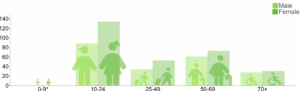
Dowlatabadi, Sophia, Preim, Bernhard, Meuschke, Monique
Visualization of Age Distributions as Elements of Medical Data-Stories Journal Article
In: arXiv preprint arXiv:2409.17854, 2024.
BibTeX | Links:
@article{dowlatabadi2024visualization,

title = {Visualization of Age Distributions as Elements of Medical Data-Stories},

author = {Sophia Dowlatabadi and Bernhard Preim and Monique Meuschke},

url = {https://arxiv.org/pdf/2409.17854},

year  = {2024},

date = {2024-01-01},

urldate = {2024-01-01},

journal = {arXiv preprint arXiv:2409.17854},

keywords = {},

pubstate = {published},

tppubtype = {article}

}
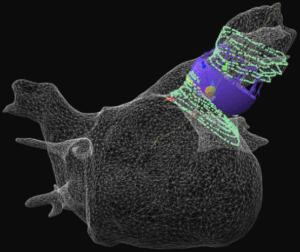
Nuhic, Jasna, Albors, Carlos, Mill, Jordi, Olivares, Andy L, Camara, Oscar, Meuschke, Monique
Comparative visualization of in-silico hemodynamic indices with different left atrial appendage occluder configurations Proceedings Article
In: Proc. of Computer Assisted Radiology and Surgery, 2024.
BibTeX | Links:
@inproceedings{Nuhic_CARS_24,

title = {Comparative visualization of in-silico hemodynamic indices with different left atrial appendage occluder configurations},

author = {Jasna Nuhic and Carlos Albors and Jordi Mill and Andy L Olivares and Oscar Camara and Monique Meuschke},

url = {https://link.springer.com/content/pdf/10.1007/s11548-024-03128-9.pdf},

doi = {https://doi.org/10.1007/s11548-024-03128-9},

year  = {2024},

date = {2024-01-01},

booktitle = {Proc. of Computer Assisted Radiology and Surgery},

volume = {19},

keywords = {},

pubstate = {published},

tppubtype = {inproceedings}

}
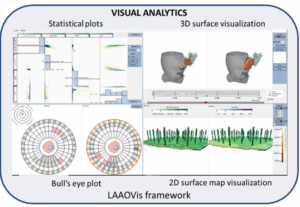
Nuhic, Jasna, Albors, Carlos, Mill, Jordi, Olivares, Andy L, Camara, Oscar, Meuschke, Monique
Visual Analytics for Planning Left Atrial Appendage Occlusion: A Case Study on In-silico Hemodynamic Assessment Proceedings Article
In: EuroVis 2024 - Short Papers, 2024.
BibTeX | Links:
@inproceedings{Nuhic_EuroVis_24,

title = {Visual Analytics for Planning Left Atrial Appendage Occlusion: A Case Study on In-silico Hemodynamic Assessment},

author = {Jasna Nuhic and Carlos Albors and Jordi Mill and Andy L Olivares and Oscar Camara and Monique Meuschke},

url = {https://diglib.eg.org/bitstreams/6e3edc3f-4ed3-47a1-be5d-e86eb3927f20/download},

doi = {10.2312/evs.20241065},

year  = {2024},

date = {2024-01-01},

booktitle = {EuroVis 2024 - Short Papers},

keywords = {},

pubstate = {published},

tppubtype = {inproceedings}

}
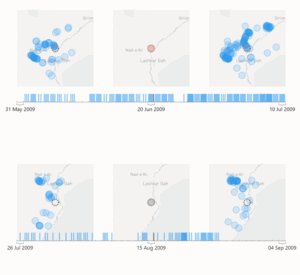
Mayer, Benedikt, Donnay, Karsten, Lawonn, Kai, Preim, Bernhard, Meuschke, Monique
Expert exploranation for communicating scientific methods - A case study in conflict research Journal Article
In: Computers & Graphics, vol. 120, pp. 103937, 2024.
BibTeX | Links:
@article{Mayer2024b,

title = {Expert exploranation for communicating scientific methods - A case study in conflict research},

author = {Benedikt Mayer and Karsten Donnay and Kai Lawonn and Bernhard Preim and Monique Meuschke},

url = {https://www.sciencedirect.com/science/article/pii/S0097849324000724?via%3Dihub},

doi = {https://doi.org/10.1016/j.cag.2024.103937},

year  = {2024},

date = {2024-01-01},

urldate = {2024-01-01},

journal = {Computers & Graphics},

volume = {120},

pages = {103937},

publisher = {Elsevier},

keywords = {},

pubstate = {published},

tppubtype = {article}

}
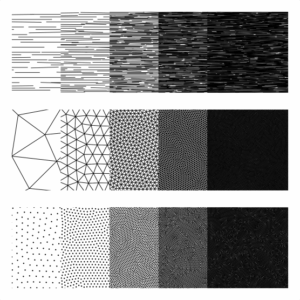
Sterzik, Anna, Meuschke, Monique, Cunningham, Douglas W, Lawonn, Kai
Perceptually Uniform Construction of Illustrative Textures Journal Article
In: IEEE Transactions on Visualization and Computer Graphics, vol. 30, no. 1, pp. 1052–1062, 2024.
BibTeX | Links:
@article{Sterzik2023_TVCG,

title = {Perceptually Uniform Construction of Illustrative Textures},

author = {Anna Sterzik and Monique Meuschke and Douglas W Cunningham and Kai Lawonn},

url = {https://arxiv.org/abs/2308.03644},

doi = {https://doi.org/10.1109/TVCG.2023.3326574},

year  = {2024},

date = {2024-01-01},

urldate = {2024-01-01},

journal = {IEEE Transactions on Visualization and Computer Graphics},

volume = {30},

number = {1},

pages = {1052–1062},

keywords = {},

pubstate = {published},

tppubtype = {article}

}
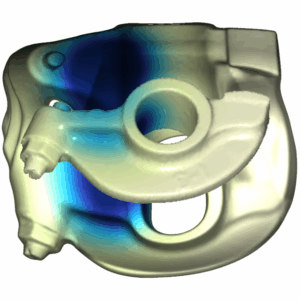
Lawonn, Kai, Meuschke, Monique, Günther, Tobias
InverseVis: Revealing the Hidden with Curved Sphere Tracing Journal Article
In: Computer Graphics Forum, vol. 43, no. 3, pp. in print, 2024.
BibTeX | Links:
@article{Lawonn2024_CGF,

title = {InverseVis: Revealing the Hidden with Curved Sphere Tracing},

author = {Kai Lawonn and Monique Meuschke and Tobias Günther},

url = {https://onlinelibrary.wiley.com/doi/epdf/10.1111/cgf.15080


https://youtu.be/fJxXrmTOkMU},

doi = {https://doi.org/10.1111/cgf.15080},

year  = {2024},

date = {2024-01-01},

urldate = {2024-01-01},

journal = {Computer Graphics Forum},

volume = {43},

number = {3},

pages = {in print},

keywords = {},

pubstate = {published},

tppubtype = {article}

}